"“We have lent a huge amount of money to the U.S. Of course we are concerned about the safety of our assets. To be honest, I am definitely a little worried.” "


Chinese premier Wen Jiabao 12th March 2009


""We have a financial system that is run by private shareholders, managed by private institutions, and we'd like to do our best to preserve that system."


Timothy Geithner US Secretary of the Treasury, previously President of the Federal Reserve Bank of New York.1/3/2009

Showing posts with label Globalisation. Show all posts

Thursday, July 26, 2007

Record Oil prices as Chinese Stock Market hits record high

On the back of a report by the International Energy Agency which forecast oil demand growth will grow more quickly in 2008 than this year, U.S. Energy Department's weekly supply report showed several things that has affected the global energy markets today ;

1. Imports of gasoline rose by 737,000 barrels a day to an average of 1.65 million barrels per day last week, the highest weekly average ever.

2. US Refinery utilization grew by 0.7 % to 91.7 % and gasoline inventories grew by 800,000 barrels in the week ended July 20.

3. There was 1.4 million barrel decline in oil inventories in and around the Cushing, Oklahoma, delivery point for crude traded on NYMEX

As a consequence ....

Texas Light, sweet crude for September delivery on NYMEX rose 98 cents to $76.86 a barrel in electronic trading by midday in Europe. The contract had risen $2.32 to $75.88 on Wednesday.

September Brent crude settled at US$77.57 a barrel on the ICE Futures exchange in London.(US$1 off Aug 2006 all time record of US$78.65). An increasing concern is damage to the North Sea Central Area Transmission System (CATS) gas pipeline,which shut on July 1 after its conrete casing was damaged by a ship's anchor near Teesside port. Divers are inspecting the damage and operators BP Chief Executive Tony Hayward also told a news conference that it would be a number of weeks before repairs would be complete.As gas cannot be extracted this also affects oil production.

The 404 Km seabed CATS pipeline brigs gas ashore at Teesside from the Armada, Seymour, North Everest, Banff, Eastern Trough Area Project, J-Block, Lomond and Erskine fields U.K. gas network operator National Grid PLC NGG. The pipe has previously been delivering gas at a rate of just over 40 Mn cubic metres a week.

NYMEX heating oil rose 1.52 cent to $2.0811 a gallon while gasoline futures gained 2.16 cents to $2.1095 a gallon. Natural gas prices added 4.5 cents to $5.970 per 1,000 cubic feet.

Meanwhile ....

In China the benchmark Shanghai Composite Index rose 22.49 points, or 0.52 %, to close at a record 4,346.46 this index has risen more than 62 % so far this year and 14 % since July 1st after more than doubling in 2006.

National Bureau of Statistics (NBS)announced this week that China's gross domestic product soared 11.9% in the Q2 2007, up 0.8% on Q1 growth of 11.1%. China is on track to overtake Germany as the third-largest economy worldwide.

Friday, May 11, 2007

German State crackdown on G-8 Activists leads to street protests

German observers feel that the 40 or more police raids in Berlin, Hamburg and elsewhere in Germany on Wednesday were aimed at intimidating protesters ahead of the G-8 summit with some commentators claiming that the operation was far too heavy-handed. (Pic the poster says Stop the G8)

German Police raided known leftist organizations across Germany in what was said to be a move to round up activists who are are accused of plotting terror attacks ahead of the G-8 summit in June in Heiligendamm on Germany's Baltic coast.

The raids in Berlin and Hamburg were said to be aimed at preventing violence by anti-globalization activists , presumably to head off displays seen at Genoa in 2001 or Saint Petersburg last year.

The inevitable result was that many thousands protested in the streets on Wednesday and threw bottles and fireworks at police in Hamburg where the high profile left-wing center "Rote Flora," was raided and police confiscated computers and files.

Die Welt said this would be represented by the left as deliberate provocation and demonstrated the need for self defense against a 'totalitarian state.' Although there have been minor events in the area including the burning of a car in front of the home of Thomas Mirow the deputy finance minister nobody has been arrested or charged.

Die Tageszeitung said that it was unclear whether the police had any legal basis for such searches - they doubt whether Paragraph 129a of the criminal code which deals with the training and support of a terrorist organization -- could be applied in this instance at all. The Federal Prosecutor's Office got what they wanted however, which was to demonstrate that they would crack down not only on people planning to disturb or prevent the forthcoming world economic summit using arson attacks and other violent means would be nipped in the bud.

Coming swiftly after the release and non-release of Red Army faction prisoners and the agitators and says the Süddeutsche Zeitung, " Police and law enforcement authorities are using it as an excuse for wide-ranging investigations and fishing expeditions."

Long hot summer in prospect. (poster reads "Ram & sink G-8)

Wednesday, November 01, 2006

BBW European Wind Farms run out of puff - CEO moves on

Whilst there is a great deal of interest in using "free" wind energy to generate electricity, there is much optimistic noise made so investment in the sector looks increasingly attractive because of ..

1. The increasing cost competitiveness of wind energy
2. Need for increased security of energy supply, particularly by those countries with
limited fossil fuel reserves
3. Concerns about rising CO2 emissions and global warming
4. Increased global demand and for electricity - expected to double between 2002 and 2030,

Despite all this it is still difficult to identify the costs / benefits. Therefore it is interesting to consider the performance of Sydnay based Babcock & Brown Wind Partners.

A global investment company spun off investment company Babcock and Brown and listed on the Australian Stock Exchange on 28 October 2005 @ an application price of Aus$1.40 they now after a lengthy decine over 12 months from a high of over Aus$2 have hit Aus$1.43. They have a market value of approximately Aus$850Mn.

The company owns or has interests in a globally diverse wind energy portfolio with a total gross installed capacity of 671.6 MW , Europe (26%), North America (49%) and Australia (25%). They currently operate 2 wind farms in Australia (100%), 5 in the US (40% min), 2 in Germany (99%) and 6 in Spain (100%).

The business model appears relatively fool proof . Costs are fixed for operation and maintenance and sizeable proportion of electricity produced is sold under offtake contracts with large established utilities. These include - Australia AGL; Country Energy; Alinta . US TXU; Pacific Corp
· Germany RWE Rhein Ruhr · Spain Endesa . Most sites are partly owned and financed with local currency limited debt financing with hedged interest rates (except in the US) so providing a high theoretical stable cashflow.

There are different regulatory regimes which affect tax treatments ... all focused on promoting growth in renewable energy generation and use.

Direct Tariffs

Germany - Renewable Energy Sources Act (EEG) 2004
Spain - Electricity Act 1997 & Associated Royal Decrees
France - Electricity Law 2000 & subsequent Decrees

Quota Systems

Australia - Renewable Energy (Electricity) Act 2000 and Mandatory Renewable Energy Target

Tax Credits

US - Energy Policy Act of 2005, Production Tax Credit Incentives

Strong government support, especially in Europe, has helped the growth of wind energy and there is now said to be nearly US$20 billion invested annually – which has helped to contribute to a
reduction in cost of energy to about 4-7 US cents/ kWh depending on the specifi c wind resource. Wind energy capacity additions accounted for about 10% of total new electricity generation added
globally in 2006.

This strong growth in wind energy is forecast to continue at 20% a year according to Emerging Energy Research. Wind energy is expected to account for approximately 3% of global electricity generation by 2015. Offshore wind energy development is not expected to make any significant effect until after 2015.

However the results discussed at yesterday's AGM are disappointing, with Revenues of Aus$73 Mn they could distribute 10.2 cents a share.They booked a net loss of $16.24 million for 2005/06

Problems arose locally due to "non recurring items"

1. Delays in the acquisition of the Olivo wind farms in Spain
2. Delay in the construction of the Niederrhein wind farms in Germany.
3. Low wind conditions in May and June 2006 across the European portfolio (!)
3. Low wind conditions at the Lake Bonney 1 (Aus) site. (!) (the whole of their output is on a a single long term offtake contract with a term of 10 years with Country Energy)

How they can claim low wind conditions are "non - recurring" is a little difficult to unravel. ...but any sailor will tell you the wind is fickle and unreliable.

CEO Peter O'Connell stepped down to take up a role elswehere in Babcock & Brown and a search for a new chief executive is underway.

Making money out of wind energy is evidently not all plain sailing. Watch this space.

Friday, September 22, 2006

Fray Bentos Pulp Mill to be re-located in Uruguay

Patricia Avila of Reuters Alertnet reports from Montevideo, Uruguay ,that Juan Luis Arregui, President of Spain's ENCE, who were to build a pulp mill at Fray Bentos (with the help of World Bank funds) near a plant built by a Finnish Consortium Botnia will move the location of the new plant but no firm plans have been announced.

He admitted that Fray Bentos, a town on the Uruguay River that divides Argentina and Uruguay , does not have enough infrastructure to support the two massive plants.

Arregui said the decision was not related to the environmental conflicts that had arisen, although he had said earlier that the company had halted progress on the plant until the differences with Argentina were resolved.

Relations between Uruguay and Argentina have been strained by the project, which represents the biggest private investment ever in Uruguay.The dispute was finally resolved by the United Nations' highest court, which rejected Argentina's request to suspend conbstruction of both plants.

A strike had halted Botnia's construction works as local workers opposed a plan by the Finnish firm to contract hundreds of building workers from Eastern Europe.

ENCE said on Wednesday it had laid off 40 of its administrative personnel out of a total of 60, in Montevideo, but Arregui said the company was not planning to leave Uruguay where they own massive Eucalyptus plantations.

"It has never crossed our mind to leave Uruguay. The layoffs announced are part of a restructuring," Arregui said.

Of course if the plant was moved to Argentina, their objections would probably dissolve, but as this would involve transporting Uruguayan timber across the river it would be economic nonsense.

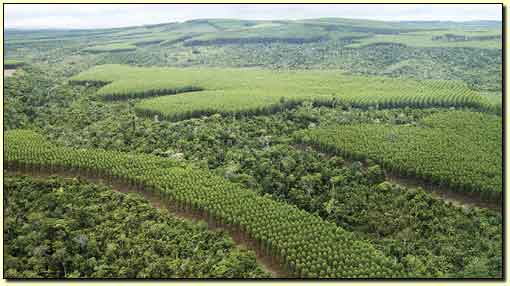
Lord Patel wrote about the whole history of this last week. Globalisation - a winning solution in Uruguay. (Pic Brazilian Eucalyptus plantations)

Tuesday, September 19, 2006

Globalisation - a winning solution in Uruguay

This is a lengthy tale but bear with me.

PART 1 . The Globalistas

Oy Metsä-Botnia Ab - was founded in 1973, and is jointly owned by :

M-real Oyj, is a high quality paper producer with headquarters in Espoo, Finland, and a presence in over 70 countries and approximately 15,500 employees with sales revenues of 5.2 BN Euros.

Metsäliitto Osuuskunta, the tenth biggest forest industry group in the world /wood supply / wood products industry / pulp production /and tissues, With sales of 8.6 billion euro they have 30,000 employees in 30 countries. Metsäliitto Cooperative is a cooperative organisation for Finnish forest owners and has over 130,000 members.


UPM-Kymmene Oyj. have 22 paper mills in eight countries: Austria, Canada, China, Finland, France, Germany, the UK and the USA, 31,000 employees and sales of 8.6 Bn Euros to 3,200 customers in 120 countries. The company was the result of merging 3 major Finnish paper manufacturers and The new company started its operations May 1, 1996. They are quoted on the Helsinki and NY stock Exchanges.The first quarter profit in 2006 was 181 Mn Euros.

The joint company Oy Metsä-Botnia Ab have pulp mills in Finland in Joutseno, Kaskinen, Kemi, Rauma (which uses chlorine free technology (TCF)), and Äänekoski it manufactures high quality bleached pulp grades from softwoods, birch, and aspen pulp tissue.under the name Botnia. Botnia's pulp grades have been developed for the manufacture of high quality printing papers, folding box boards, and tissue.

Large-scale eucalyptus plantations were introduced in Uruguay in 1988, promoted mainly by the World Bank and the Inter-American Development Bank (IDB), with the active participation of forestry companies to replace hardwood logging.

At the time, the price of pulpwood on the world market was $60 a ton (it is now $23 to $28 per ton,)and Botnia established a company in Uruguay Compañia Forestal Oriental S.A. (FOSA) in Uruguay, which was first established by Shell/Kymmene to promote eucalyptus cultivation which had commenced planting in 1991. Eucalyptus is a genus of trees confined originally to Australasia , however the fast growth of eucalyptus plantations (8 years to harvest at up to 90 feet high - which relates to extreme water demands) provides low cost high quality feedstock for bleached hardwood pulp. FOSA with partners UPM (38.6 %) and Finnfund (1.4 %) own 100.000 hectares of land (400 sq. miles) , of which 60.000 is good-quality eucalyptus forest that has been planted on grassland. FOSA is one of the three big forest owners in Uruguay and is certified under under the FSC standard (Forest Stewardship Standard).

María Selva Ortiz of REDES - member of the Friends of the Earth non-governmental environmental network says foreign-owned large-scale plantations of eucalyptus occupy more than 700,000 hectares (2,700 square miles) in Uruguay.

In conjunction with this investment it was decided to build a pulp mill at Fray Bentos (pop 20,000) on the Uruguay River, which is Argentine / Uruguay border. An environmental impact assessment for the pulp mill as well as an evaluation of its socio-economic impacts were started in November 2003.

This US$1 Bn. pulp mill project is the biggest industrial investment in Uruguay's history and is estimated to grow Uruguay's GNP by 1.6 per cent. The project is also the biggest industrial private sector investment by Finland abroad.

The plant will incoporate a Kyoto Protocol / Clean Development Mechanism (CDM) 32 MW biomass-based low carbin emission electricity generator on the mill site using the latest technology to use black liquor from the pulping process for steam and electricity generation in the recovery boiler. This saving in greenhouse gases translates into sales / income when traded against the European Emissions Trading Scheme (ETS).

This project is designed to generate surplus electricity which can be used outside the mill site. The amount of surplus electricity is estimated at 270 GWh annually. Enough to supply the electricity needs of 150,000 Uruguayan homes.

Another major transnational corporation, the U.S.- based forestry giant Weyerhaeuser, with partner Global Forest Partners a US based forest investments house, has purchased roughly 135,000 hectares (521 square miles) mostly grassland, since 1997. Two-thirds of it has been planted with loblolly pine and fast-growing eucalyptus and recently announced plans to invest $1.2 billion to expand its Uruguayan pulp operations.

Weyerhaeuser (NYSE: WY) is a multinational corporation based in Washington, United States. The company is now the second largest pulp and paper company in the world, soon to be second, with the acquisition of Domtar Inc. on August 23, 2006 $3.3 billion US cash-and-stock deal. Thye have manufacturing operations in the United States, Canada, Australia, New Zealand, China, Mexico, Ireland, France and Uruguay, among others. It is the world's largest private owner of softwood timberland, managing 38 million acres (154,000 km²) in five countries.

It is the third largest owner in the United States, behind Plum Creek Timber and International Paper of timber lands. Weyerhaeuser has approximately 55,200 employees in 18 countries (primarily in the U.S. and Canada).

Finnish group Stora Enso (quoted on Helsinki / Stockholm exchanges and ADR's NYSE) have sales of 13.2 Bn. Euros in 2005,with 46,000 employees in more than 40 countries on five continents.The company has been buying land in the Rio Negro region (250 KM from port of Montevideo) region and have assembled to date at least 56,000 hectares and are planting 50% eucalyptus and 50% pine. They already have established Veracel in Brazil with their Brazil-based partner Veracruz with a plantation / pulp mill which came into operation last year with 5 500 employees and annual pulp production 900 000 tonnes of pulp annually (to reach 1 150 000 t/y) and 79 000 ha of their own plantations. Veracel 2 in Rio Grande do Sul is on the drawing Boards.

Stora Enso signed an agreement in November 2005, with Gaofeng Forest - Pulp & Paper Company that will enable Stora Enso to increase its land concession rights and wholly owned plantations in southern China to approximately 60,000 ha.

Empresa Nacional de Celulosa de España (ENCE) is a company quoted on the Spanish Stock Exchange and is the number one owner of Eucalypt timberland in Europe as well as being the leading producer in Europe and number two in the world of eucalyptus-based pulp.

ENCE's Uruguayan subsidiary EUFORES has been a pioneer within the forestry development of Uruguay. As well as establishing plantations, EUFORES manages nature zones and old forest reserves, water-meadows and palm groves. It is establishing a conservation and breeding ground for endangered species in the surroundings of M´Bopicuá.

The company's forest resources cover 53,000 hectares, of which 94% are its own property. EUFORES is the largest exporter of pulping wood in Uruguay.

ENCE announced plans to build a pulp mill at Fray Bentos last year with a capacity of 500,000 tons of pulp annually (1/3rd the size of the Botnia plant which will be the wrold's largest).


PART 2 The Globalised

Uruguay with a population of 3.4 Million rarely hits headlines unless their football team does well. Figures published by the Central Bank today show that the Uruguayan economy is booming, overall the economy grew 8.4 % in Jan/June '06 compared with last year and 3.5% growth in the 2nd Qtr over the 1st Quarter.

In June the Bank reported GDP growth of 7.2 % over 2005.The IMF raised its 2006 economic growth forecast for Uruguay to 5 percent from 4.6 percent.

In Jan / June this year , manufacturing output jumped 21.1 % from last year and exports rose 16.2 % to $1.88 billion.The construction sector grew 13.4 % due esentially to the building of a new power plant by the state energy company and public works in Rio Negro province, ENCE and Botnia are building their pulp mills.

The farm sector, grew 5.4 % in the first six months of the year due to an increase in beef production and exports.

In 1988, the World Bank and the Inter-American Development Bank (IDB), initiated the planting of eucalyptus plantations. Pulpwood the economists noted was US$60 a tonne, demand was high and people like thw World Bank were being accused of financing tropical rain forest destruction. It was claimed that indiscriminate logging of trees for pulp production around the world, was consuming 15 million hectares (58,000 square miles) annually.

In the climate controlled offices of the paper manufacturers in distant Spain and frosty Finland. Uruguay appeared as an ideal location for the fast growing and fast cropping Eucalypts. Montevideo pledged full compliance and provided forestry companies with generous subsidies, soft credits, and tax exemptions. Over 12 years, the Uruguayan government’s support for this sector exceeded $500 million in tax exemptions and direct disbursements, an amount representing almost 4 percent of the country’s annual GDP. To facilitate the transportation and export of the wood, the governments of the day made further investments in new ports, bridges, roads, and railway lines.

Part of the grand plan was of course the building of pulp mills - hungry, like the trees, for water. The World Bank, lobbed loans of US£200 Mn. each to Botnia (The Orion Mill) and ENCE (The CMB Mill) who will jointly "invest" US$2 Bn. This is the largest direct private investment ever in the country’s history (Population 3.4m) , according to figures released by Minister of the Economy Danilo Astori and Ministe of Industry Jorge Lepra.

Much of the Uruguayan economic and governmental leadership, supports the project and is actively encouraging this agro-industrial project, A Cumulative Impact STudy comparing the plans with Best Intrenational practice in Canada and Scandinavia show that whilst there is pollution it will appear anywhere you build the factory.

Principally the main resistance to the project is Argentina, smarting, it is said that the project is not theirs.

Surely this is an ideal project, it promotes sustainability, replaces logged forests, provides national income, employment in construction and continuing development.

Of course, much of the investment dollars end up in the developed world for the new generation of pulping plants which utilise the black liquor re-cycling which has been invented in Scandinavia and whose re-use will provide sustainable low cost, low emission electricity for the local population.

It is an irrefutable fact that the economic benefits are coming through .... and the pulping plants are not yet complete.

(C) Very Seriously Disorganised Criminals 2002/3/4/5/6/7/8/9 - copy anything you wish