"“We have lent a huge amount of money to the U.S. Of course we are concerned about the safety of our assets. To be honest, I am definitely a little worried.” "


Chinese premier Wen Jiabao 12th March 2009


""We have a financial system that is run by private shareholders, managed by private institutions, and we'd like to do our best to preserve that system."


Timothy Geithner US Secretary of the Treasury, previously President of the Federal Reserve Bank of New York.1/3/2009

Showing posts sorted by relevance for query Uruguay. Sort by date Show all posts

Tuesday, September 19, 2006

Globalisation - a winning solution in Uruguay

This is a lengthy tale but bear with me.

PART 1 . The Globalistas

Oy Metsä-Botnia Ab - was founded in 1973, and is jointly owned by :

M-real Oyj, is a high quality paper producer with headquarters in Espoo, Finland, and a presence in over 70 countries and approximately 15,500 employees with sales revenues of 5.2 BN Euros.

Metsäliitto Osuuskunta, the tenth biggest forest industry group in the world /wood supply / wood products industry / pulp production /and tissues, With sales of 8.6 billion euro they have 30,000 employees in 30 countries. Metsäliitto Cooperative is a cooperative organisation for Finnish forest owners and has over 130,000 members.


UPM-Kymmene Oyj. have 22 paper mills in eight countries: Austria, Canada, China, Finland, France, Germany, the UK and the USA, 31,000 employees and sales of 8.6 Bn Euros to 3,200 customers in 120 countries. The company was the result of merging 3 major Finnish paper manufacturers and The new company started its operations May 1, 1996. They are quoted on the Helsinki and NY stock Exchanges.The first quarter profit in 2006 was 181 Mn Euros.

The joint company Oy Metsä-Botnia Ab have pulp mills in Finland in Joutseno, Kaskinen, Kemi, Rauma (which uses chlorine free technology (TCF)), and Äänekoski it manufactures high quality bleached pulp grades from softwoods, birch, and aspen pulp tissue.under the name Botnia. Botnia's pulp grades have been developed for the manufacture of high quality printing papers, folding box boards, and tissue.

Large-scale eucalyptus plantations were introduced in Uruguay in 1988, promoted mainly by the World Bank and the Inter-American Development Bank (IDB), with the active participation of forestry companies to replace hardwood logging.

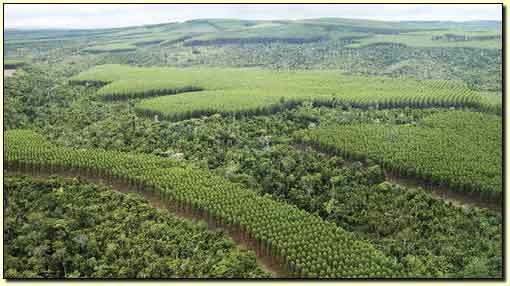
At the time, the price of pulpwood on the world market was $60 a ton (it is now $23 to $28 per ton,)and Botnia established a company in Uruguay Compañia Forestal Oriental S.A. (FOSA) in Uruguay, which was first established by Shell/Kymmene to promote eucalyptus cultivation which had commenced planting in 1991. Eucalyptus is a genus of trees confined originally to Australasia , however the fast growth of eucalyptus plantations (8 years to harvest at up to 90 feet high - which relates to extreme water demands) provides low cost high quality feedstock for bleached hardwood pulp. FOSA with partners UPM (38.6 %) and Finnfund (1.4 %) own 100.000 hectares of land (400 sq. miles) , of which 60.000 is good-quality eucalyptus forest that has been planted on grassland. FOSA is one of the three big forest owners in Uruguay and is certified under under the FSC standard (Forest Stewardship Standard).

María Selva Ortiz of REDES - member of the Friends of the Earth non-governmental environmental network says foreign-owned large-scale plantations of eucalyptus occupy more than 700,000 hectares (2,700 square miles) in Uruguay.

In conjunction with this investment it was decided to build a pulp mill at Fray Bentos (pop 20,000) on the Uruguay River, which is Argentine / Uruguay border. An environmental impact assessment for the pulp mill as well as an evaluation of its socio-economic impacts were started in November 2003.

This US$1 Bn. pulp mill project is the biggest industrial investment in Uruguay's history and is estimated to grow Uruguay's GNP by 1.6 per cent. The project is also the biggest industrial private sector investment by Finland abroad.

The plant will incoporate a Kyoto Protocol / Clean Development Mechanism (CDM) 32 MW biomass-based low carbin emission electricity generator on the mill site using the latest technology to use black liquor from the pulping process for steam and electricity generation in the recovery boiler. This saving in greenhouse gases translates into sales / income when traded against the European Emissions Trading Scheme (ETS).

This project is designed to generate surplus electricity which can be used outside the mill site. The amount of surplus electricity is estimated at 270 GWh annually. Enough to supply the electricity needs of 150,000 Uruguayan homes.

Another major transnational corporation, the U.S.- based forestry giant Weyerhaeuser, with partner Global Forest Partners a US based forest investments house, has purchased roughly 135,000 hectares (521 square miles) mostly grassland, since 1997. Two-thirds of it has been planted with loblolly pine and fast-growing eucalyptus and recently announced plans to invest $1.2 billion to expand its Uruguayan pulp operations.

Weyerhaeuser (NYSE: WY) is a multinational corporation based in Washington, United States. The company is now the second largest pulp and paper company in the world, soon to be second, with the acquisition of Domtar Inc. on August 23, 2006 $3.3 billion US cash-and-stock deal. Thye have manufacturing operations in the United States, Canada, Australia, New Zealand, China, Mexico, Ireland, France and Uruguay, among others. It is the world's largest private owner of softwood timberland, managing 38 million acres (154,000 km²) in five countries.

It is the third largest owner in the United States, behind Plum Creek Timber and International Paper of timber lands. Weyerhaeuser has approximately 55,200 employees in 18 countries (primarily in the U.S. and Canada).

Finnish group Stora Enso (quoted on Helsinki / Stockholm exchanges and ADR's NYSE) have sales of 13.2 Bn. Euros in 2005,with 46,000 employees in more than 40 countries on five continents.The company has been buying land in the Rio Negro region (250 KM from port of Montevideo) region and have assembled to date at least 56,000 hectares and are planting 50% eucalyptus and 50% pine. They already have established Veracel in Brazil with their Brazil-based partner Veracruz with a plantation / pulp mill which came into operation last year with 5 500 employees and annual pulp production 900 000 tonnes of pulp annually (to reach 1 150 000 t/y) and 79 000 ha of their own plantations. Veracel 2 in Rio Grande do Sul is on the drawing Boards.

Stora Enso signed an agreement in November 2005, with Gaofeng Forest - Pulp & Paper Company that will enable Stora Enso to increase its land concession rights and wholly owned plantations in southern China to approximately 60,000 ha.

Empresa Nacional de Celulosa de España (ENCE) is a company quoted on the Spanish Stock Exchange and is the number one owner of Eucalypt timberland in Europe as well as being the leading producer in Europe and number two in the world of eucalyptus-based pulp.

ENCE's Uruguayan subsidiary EUFORES has been a pioneer within the forestry development of Uruguay. As well as establishing plantations, EUFORES manages nature zones and old forest reserves, water-meadows and palm groves. It is establishing a conservation and breeding ground for endangered species in the surroundings of M´Bopicuá.

The company's forest resources cover 53,000 hectares, of which 94% are its own property. EUFORES is the largest exporter of pulping wood in Uruguay.

ENCE announced plans to build a pulp mill at Fray Bentos last year with a capacity of 500,000 tons of pulp annually (1/3rd the size of the Botnia plant which will be the wrold's largest).


PART 2 The Globalised

Uruguay with a population of 3.4 Million rarely hits headlines unless their football team does well. Figures published by the Central Bank today show that the Uruguayan economy is booming, overall the economy grew 8.4 % in Jan/June '06 compared with last year and 3.5% growth in the 2nd Qtr over the 1st Quarter.

In June the Bank reported GDP growth of 7.2 % over 2005.The IMF raised its 2006 economic growth forecast for Uruguay to 5 percent from 4.6 percent.

In Jan / June this year , manufacturing output jumped 21.1 % from last year and exports rose 16.2 % to $1.88 billion.The construction sector grew 13.4 % due esentially to the building of a new power plant by the state energy company and public works in Rio Negro province, ENCE and Botnia are building their pulp mills.

The farm sector, grew 5.4 % in the first six months of the year due to an increase in beef production and exports.

In 1988, the World Bank and the Inter-American Development Bank (IDB), initiated the planting of eucalyptus plantations. Pulpwood the economists noted was US$60 a tonne, demand was high and people like thw World Bank were being accused of financing tropical rain forest destruction. It was claimed that indiscriminate logging of trees for pulp production around the world, was consuming 15 million hectares (58,000 square miles) annually.

In the climate controlled offices of the paper manufacturers in distant Spain and frosty Finland. Uruguay appeared as an ideal location for the fast growing and fast cropping Eucalypts. Montevideo pledged full compliance and provided forestry companies with generous subsidies, soft credits, and tax exemptions. Over 12 years, the Uruguayan government’s support for this sector exceeded $500 million in tax exemptions and direct disbursements, an amount representing almost 4 percent of the country’s annual GDP. To facilitate the transportation and export of the wood, the governments of the day made further investments in new ports, bridges, roads, and railway lines.

Part of the grand plan was of course the building of pulp mills - hungry, like the trees, for water. The World Bank, lobbed loans of US£200 Mn. each to Botnia (The Orion Mill) and ENCE (The CMB Mill) who will jointly "invest" US$2 Bn. This is the largest direct private investment ever in the country’s history (Population 3.4m) , according to figures released by Minister of the Economy Danilo Astori and Ministe of Industry Jorge Lepra.

Much of the Uruguayan economic and governmental leadership, supports the project and is actively encouraging this agro-industrial project, A Cumulative Impact STudy comparing the plans with Best Intrenational practice in Canada and Scandinavia show that whilst there is pollution it will appear anywhere you build the factory.

Principally the main resistance to the project is Argentina, smarting, it is said that the project is not theirs.

Surely this is an ideal project, it promotes sustainability, replaces logged forests, provides national income, employment in construction and continuing development.

Of course, much of the investment dollars end up in the developed world for the new generation of pulping plants which utilise the black liquor re-cycling which has been invented in Scandinavia and whose re-use will provide sustainable low cost, low emission electricity for the local population.

It is an irrefutable fact that the economic benefits are coming through .... and the pulping plants are not yet complete.

Friday, September 22, 2006

Fray Bentos Pulp Mill to be re-located in Uruguay

Patricia Avila of Reuters Alertnet reports from Montevideo, Uruguay ,that Juan Luis Arregui, President of Spain's ENCE, who were to build a pulp mill at Fray Bentos (with the help of World Bank funds) near a plant built by a Finnish Consortium Botnia will move the location of the new plant but no firm plans have been announced.

He admitted that Fray Bentos, a town on the Uruguay River that divides Argentina and Uruguay , does not have enough infrastructure to support the two massive plants.

Arregui said the decision was not related to the environmental conflicts that had arisen, although he had said earlier that the company had halted progress on the plant until the differences with Argentina were resolved.

Relations between Uruguay and Argentina have been strained by the project, which represents the biggest private investment ever in Uruguay.The dispute was finally resolved by the United Nations' highest court, which rejected Argentina's request to suspend conbstruction of both plants.

A strike had halted Botnia's construction works as local workers opposed a plan by the Finnish firm to contract hundreds of building workers from Eastern Europe.

ENCE said on Wednesday it had laid off 40 of its administrative personnel out of a total of 60, in Montevideo, but Arregui said the company was not planning to leave Uruguay where they own massive Eucalyptus plantations.

"It has never crossed our mind to leave Uruguay. The layoffs announced are part of a restructuring," Arregui said.

Of course if the plant was moved to Argentina, their objections would probably dissolve, but as this would involve transporting Uruguayan timber across the river it would be economic nonsense.

Lord Patel wrote about the whole history of this last week. Globalisation - a winning solution in Uruguay. (Pic Brazilian Eucalyptus plantations)

Tuesday, August 16, 2005

Chavez secures South American markets for his oil in South Am..then tells George Bush to Fuck Off

Venezuela’s President Chavez spent 4 days on trip to key allies in the Southern Cone Economic Zone (Mercosur) countries, consolidating his vision of a South American energy structure… and according to his allies north of the Gulf of Mexico, reeking of cheque book populism…. A method of foreign influence they are familiar with.

In Uruguay, Chavez met President Tabaré Vazquez, and signed ten agreements, including the Social Charter of the Americas which is a document the Venezuelan government has been drafting, which, if adopted by the OAS, would commit all member countries to basic social rights, just as the OAS democratic charter commits them to the upholding of political rights.

An important agreement is to promote PetroSur—the continent-wide oil company Chavez visited , La Teja, refinery near Montevideo, which Chavez said Venezuela would help bring capacity, to process 50,000 barrels of Venezuelan crude per day. The aim is to double production and at a cost of US$600 develop it to refine Venezuela’s extra-heavy crude from the Orinoco Oil Belt. A vital part of Venezuela’s commitment to Uruguay would be to guarantee Uruguay’s oil supply for the next 25 years.

In Buenos Aires, Argentina, where he met the Patagonian, Peronist President Nestor Kirchner, he and Chavez signed agreements for Venezuela’s supply of fuel oil and gas and for Argentina to construct tankers for the Venezuelan oil company’s fleet. The ship building agreement, which will generate at least 1,500 jobs, is for four tankers, worth $200 million. The first tanker will be named Eva Peron.

Chavez also went to, Rio Santiago, where a Petroleos de Venezuela (PDVSA) tanker is being repaired and where the new tankers will be built. Chavez Frias has offered to send more tankers.

President Kirchner praised Chavez Frias for the purchase of US£800Mn of Argentinean bonds, saying the gesture of solidarity will not be forgotten.

Chavez Frias says the bonds should be called the Kirchner Bonds and the purchase is a sign of Venezuela's coherence in its regional integration discourse.

It must be remembered that Argentinean President Nestor Kirchner revoked a degree on obtaining office in 2003 that prohibited the extradition of Argentine officials accused of torture or murder during the 1976-83 military dictatorship's "dirty war" against leftist opponents.


In Brasilia, Chavez met President “Lula” da Silva to further the agreements already made to increase trade between the 2 countries from US$800 Mn in 2004 to US$3 Bn in 2005.

On the joint development of energy, plans for the Pernambuco refinery to handle Venezuelan crude were moved forward, and construction on this refinery should begin before the end of 2005 although the precise site location has to be decided.

The building of a gas pipeline connecting Venezuela’s Caribbean coast with Brazil, and agreeing for Brazil’s oil company Petrobras the opportunity to produce oil in Venezuela’s Orinoco Oil Belt, he world’s largest reserves of extra-heavy crude were furthered in the attempt to integrate the continents energy integration. “We want to give priority to Latin America to exploit this immense oil wealth,” said Chavez.

Chavez came to the defence of his ally who is currently facing charges of several members of his government have been accused of corruption. “I am absolutely certain that Lula is an honest man, a great partner…,” said Chavez, adding, “I feel that there is an action of the old political class, of the Brazilian right … it is a massive attack against the president of Brazil and this must come from some planning centre here within Brazil or—watch out—from outside the country.”

As a result Chavez was able this weekend in a speech at a youth festival in Caracas (see pic),. to threaten to cut off oil exports to the United States, and denounce the "aggressive" actions of the U.S. government against Venezuela, threatening that Venezuelan oil "instead of going to the United States, could go elsewhere."

Tensions rose when Venezuela recently stopped assisting the U.S. in their "War against Drugs". (Another one they seem to have lost)The US response wasto cancel the military visas of Venezuelan military personnel, working with U.S. anti-drug agencies. Venezuela then deported U.S. Drug Enforcement Agency (DEA) officials.

Venezuela controls the largest oil reserves in South America, making it the world's fifth largest oil producer and exports a vital 1.3 million barrels a day to the United States. That's 2 tankers every day.

Chavez has George "over a barrel"...1.3 Mn of them every day.....and George doesn't like it.

Friday, May 25, 2007

Brazil, Argentina to drop the US$ for internal trade

This has been a good week for the Argentinian Economics Minister Felisa Miceli 54 , trained economist and the country's first female Economics Minister - in a country where macho has a special meaning. Argentina is undergoing a massive influx of US dollars spurred by strong international prices for the country’s export commodities, tourism and the issuing of severeign bonds.

Argentina’s international reserves reached a record US$40 Bn. this week according to the latest release from the Central Bank . The Brazilian real has risen 9.1 % this year against the US dollar , making it the best performer among the 16 most-actively traded currencies that Bloomberg tracks.

The government also reported on Tuesday that Argentina`s unemployment remained below double-digits in the first quarter, falling to 9.8% from 11.4% in the same period a year ago.

Felisa Miceli has taken this opportunity to announce that Argentina and Brazil, the 2 major economies in Mercosur , will drop the U.S. dollar in favor of a regional currency in their bilateral trade starting in October 2007 - which is when President Kirchner, 57, or his wife Cristina Fernandez de Kirchner, 54, both leaders of the ruling Peronist party, will face former Economy Minister Roberto Lavagna (who Kirchner fired) in October's presidential election.

Paradoxically Argentina's economy (2nd largest in South America) has grown more than 8.5% annually in the past 4 years after a $95 billion debt default in late 2001 and subsequent currency devaluation. Lavagna, a former Ambassador to the European Union, headed the restructuring effort. Miseli worked in Lavagna's consultantcy Ecolatina, in the beginning of the 1990s. In May 2002, she became part of Lavagna's team as a representative of the Ministry of Economy before the Central Bank during the presidency of Eduardo Duhalde and at the height of the Argentine economic crisis.

Miseli is generally seen as a follower of Lavagna, and his policies which have broadly been followed by her.

Since its foundation in 1991,South American continent's major trade alliance Mercosur has had the stated primary objective to remove obstacles to internal trade.

The transition to a (as yet unnamed) new currency, is part of a pilot project of Mercosur - whose Finance Ministers met in Paraguy this week - she said the new currency should eventually spread throughout the bloc, which also includes Paraguay, Uruguay, and Venezuela.

Bolivia, Chile, Colombia, Ecuador and Peru have associate member status of Mercosur.

Meanwhile Chavez has said Venezuela is withdrawing from the IMF as he rides the petrodollar wave - don't bet the mortgage on that as the bond market will collapse if he does exits the Washington-based organization as by "gaining economic sovereignty.'' he would trigger a so- called technical default. A clause inserted in most bonds in emerging markets stipulates that there is a default if Venezuela ``ceases to be a member of the IMF or ceases to be eligible to use the general resources of the IMF.''

Mind you he has enough in the piggy bank to pay them off if needed.

Tuesday, October 03, 2006

Bush - the real world appears before him

The White House have just snook out a massive and major change in biltaral relations in a Press release yesterday.


Consistent with the authority vested in him by the Constitution and the laws of the United States,the President / Commander in Chief has determined that ..

"it is important to the national interest of the United States to waive the prohibition of section 2007(a) of the 2002 Act with respect to Barbados, Bolivia, Brazil, Costa Rica, Croatia, Ecuador, Kenya, Mali, Malta, Mexico, Namibia, Niger, Paraguay, Peru, Samoa, Serbia, South Africa, St. Vincent and the Grenadines, Tanzania, Trinidad and Tobago, and Uruguay with respect to military assistance provided under the International Military Education and Training program, chapter 5 of part II of the Foreign Assistance Act of 1961 (22 U.S.C. 2151 et seq.); and he waives prohibition of section 2007(a) with respect to the military assistance described above with respect to these countries.

What this means is that the nations named, who have refused to sign an Article 98 agreement in which they bilaterally agreed not to bring "the other’s current or former government officials, military or other personnel before the jurisdiction of the International Criminal Court", protecting US military personnel from prosecution for War Crimes, can now receive US "military aid".

Informed readers will remember how Doug Feith scuttled around the failed Soviet States getting them to sign such bilateral agreements before handing out massive aid for military bases, hardware etc.,

Sharp eyed readers will note how a mass of states in South America and Caribbean, impenetrable to the blandishments of Bantz Craddock and SOUTHCOM can now expect lavish amounts of military aid, and general interference with their defence affairs, Ditto the Balkan states of Croatia and Serbia and a clutch of Central African States.

So that's more good news for the Military Industrial complex... just ahead of an election that needs some serious money spending to preserve Republican vigour.

Real politik.

Monday, October 10, 2005

Chavez keeps tweaking the US nose .... 2nd World gets it's act together

Last month, President Chavez of Venezuela agreed deals to provide oil on preferential terms to most Caribbean nations after a meeting of regional energy ministers in Caracas. Bilateral agreements were signed with the Dominican Republic, Dominica, Grenada, Suriname, Belize, St Vincent and the Grenadines, Saint Kitts and Nevis, and Antigua and Barbuda. He has earlier concluded preferential deals with both Cuba and Jamaica. The arrangement allows participating governments to pay market price for Venezuelan oil, for just a small portion of customary up-front costs, and allows them to finance the rest of the payments over 25 years at one percent interest if oil prices exceed $US40 per barrel.

Governments could also pay for part of the cost with services or goods such as rice, bananas or sugar. Venezuela has also agreed to provide assistance in expanding shipping and refining facilities.


Leaders of South American nations, without Argentina, Colombia, Guyana, Uruguay and Surinam, met with the intention of developing a South American free-trade zone.It was the first meeting of the South American Community of Nations in Brazil's capital, Brasilia.

Venezuelan president Hugo Chavez boasted in a local press interview on Sunday that his country has a 'strong oil card' to play in its contentious relations with the US, and said its hand will be even stronger if other Latin American countries join it in a regional economic alliance.

'In Venezuela, we have a strong oil card to play on the geopolitical stage, and we're going to play it clearly in the interests of regional integration,' Chavez told the daily Clarin newspaper in an interview published on Sunday.

'It is a card that we are going to play with toughness against the toughest country in the world (but governed by 'transparency and respect'). With the United States,' Chavez said.

He stressed that Venezuela's actions will always be governed by 'transparency and respect'.

Chavez, who has offered to invest US$5 Bn in a 'South American Development Bank', has also expressed disappointment with the South American trade summit, which produced a vague program with no start-up date.


Chilean international affairs expert Juan de Dios Parra the secretary general of the Latin American Association for Human Rights, said that – to date – South America’s relations “with the rest of the world (have been) from the First World to the Third World.”

Saying that South America had been forced to eat the crumbs left by the big developed countries. He envisaged ,"... a united South America , ... there’s a new actor on the world stage made up of these countries of the Second World, which didn’t exist before now."

George had better get that call in to Pat Robertson ...REAL SOON NOW

Recent blogs on same topic here

(C) Very Seriously Disorganised Criminals 2002/3/4/5/6/7/8/9 - copy anything you wish