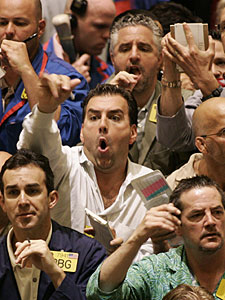
"“We have lent a huge amount of money to the U.S. Of course we are concerned about the safety of our assets. To be honest, I am definitely a little worried.” "


Chinese premier Wen Jiabao 12th March 2009


""We have a financial system that is run by private shareholders, managed by private institutions, and we'd like to do our best to preserve that system."


Timothy Geithner US Secretary of the Treasury, previously President of the Federal Reserve Bank of New York.1/3/2009

Showing posts sorted by relevance for query carbon offset. Sort by date Show all posts

Monday, July 16, 2007

Carbon Offsetting - how everyone in the media is discovering what a fucking fraud it is

Channel 4 have a Dispatches program tonight exposing the fraudulent "carbon offset" bizniz which Lord Patel has been doing for a long time -see all these posts.

It is called The Great Green Smoke Screen Channel 4 News science correspondent Tom Clarke dissects the many 'solutions' to global warming being marketed to onsumers, from tree-planting and carbon offsetting to green energy tariffs, and reveals how attempts to buy our way out of climate crisis may (good weasel word here - don't commit yourself Tom) be making things worse.


He is not the only one.. this is a good place to start ...

"Carbon Trading: A Critical Conversation on Climate Change, Privatisation and Power" a product of the Dag Hammarskjold Foundation.Which they call their Development Dialogue 2006:September, no.48 You can download (PDF alert) the whole 350 odd pages or (recommended) 6 seperate chapters.

OR

Better still obtain a free copy by e-mailing Kajsajsa.overgaard@dhf.uu.se or (in Britain only) larrylohmann@gn.apc.org or secretariat@dhf.uu.se or Fax: +46-18-12 20 72

This is how they outline the plot in an arch and quaint fashion but does give you an idea of the content - read and judge for yourself.

Chapter 1 A new fossil fuel crisis/ In which the growing climate crisis is traced mainly to the mining of coal, oil and gas; the dangers to survival and livelihood are outlined; the political nature and implications of the problem explored; and reasonable and unreasonable solutions sketched.

Chapter 2 ‘Made in the USA’ / A short history of carbon trading In which the surprising story is told of how corporations, academics, governments, United Nations agencies and environmentalists united around a neoliberal or ‘market’ approach to climate change emanating from North America.

Chapter 3 Lessons unlearned / In which carbon trading, contrary to slogans about the universal eff ectiveness of markets in dealing with environmental and social problems, is shown to be ill-suited to addressing climate change. The experience of the US in pollution trading is demonstrated to be an argument not for, but rather against, making carbon markets the centrepiece of action on global warming.

Chapter 4 Off sets / The fossil economy’s new arena of conflict In which it is shown how projects designed to compensate’ for continued fossil fuel use are helping to dispossess ordinary people of their land, water, air – and futures.

Chapter 5 Ways forward / In which the claim that ‘there is no alternative’ to carbon trading is dissected and set aside, and emerging alliances for a more democratic and effective climate politics are explored.

Pollution trading the authors have belatedly recognised is a completely new idea, foisted on the world by a small circle of neoliberal institutions in the US. Surprise - Surprise !! Pollution trading’s main appeal is that it promises to save make money for the rich over the short term.

As a pollution control policy, it is sure to fail..... ahem .. in Europe where it HAS been tried ...it has FAILED ... the ETS market closed on Friday at just 12 cents, the lowest ever....having made a lot of traders, lawyers, accountants, banks very rich on the way and many credulous investors much poorer.All credit to media lens for finally realising what twats they have been all these years as the wool has been ever so gently pulled over their eyes... quite how difficult is it to deprive children of their candy ?

Pssssst.... want to stop somebody doing something? - tax and regulate, admittedly it has limited itility eg. European fuel taxes cf USA ... but of course it depends what you do with the taxes you raise.. the European Gubments just piss them up against the wall.

Anyway read the report - 350 pages but it's big type on artfully landscaped pages and the text boxes a la US textbooks makes reading easier ... the Bibliography is excellent. See also ....See also "Obscenity' of carbon trading" by Kevin Smith in the BBC Green Room , he is a researcher with Carbon Trade Watch, a project of the Transnational Institute which studies the impacts of carbon trading on society and the environment.Also by him "Stern Words While in Europe They are trading Hot air" also at (http://www.thepolitician.org/)

"Labour MP Gerry Steinberg described the scheme as a ‘mockery’ and an ‘outrageous waste of public money’.""A massively generous allocation resulted in windfall profits for some of the UK’s most polluting companies, to the collective value of £940 million according to Franck Schuttelar, an analyst at the energy-trading firm Gaselys
.""Waiting yet more years to learn further lessons from the next round of
ineffective emissions trading is a luxury we don’t have."

See also his "Carbon Cop outs" - He is also co-author of The Carbon Neutral Myth: offset indulgences for your climate sins, forthcoming in January 2007.See also Climate Fraud and Carbon Colonialism: The New Trade in Greenhouse Gases (pdf alert)by Heidi Bachram CAPITALISM NATURE SOCIALISM VOLUME 15 NUMBER4 (DECEMBER 2004)
"The changes necessary to avert climate catastrophe are simple enough, namely, a switch away from fossil fuels and to renewable energy like solar and wind, along with a reduction in energy use generally."

You can watch Channel 4 Live on the net anywhere by going here and logging in.

An infuriating program with a few nuggets of information and a lot of footage of the telegenic reporter sitting at a laptop loking puzzled.

It has been said before ... carbon offsets are the equivalent of the mediaeval church selling indulgencies - if you don't know what they are Google it.

There is one effective way to reduce carbon dioxide emissions - and New Zealand have recently introduced it. An energy tax. Not the complete answer, not the only answer but a good start. Carbon trading just fills the wallets of financiers and their lawyers, advisors, consultants, and PR boosters. They found their top shill in the hapless, hopeless, chinless Margaret Beckett who thankfully appears to have gone to that great Caravan in the sky.

Tuesday, January 09, 2007

Carbon Black hole - ETS price drops 23% in one day.


The price of carbon on the European Trading System dropped yesterday (Monday 6th January 2007 ) to €3.88 .... 0.87 cents down - a drop of 23%, yet again the lowest ever - remember it was over €30 in May.

The market closed down a further 10% (38 cents) today Tuesday 9 January 2007 @ €3.50.

How long is it going to be before the market collapse and the fraudulent trading in this smoke and mirrors show can be kept out of the MSM ?

UPDATE MIDNIGHT GMT TUESDAY 9th Jan.

On BBC2 Newsnight Sir Nicholas Stern the mild mannered, distinguished development economist and former chief economist at the World Bank, with a reputation as a skilful and highly rated academic, a person of intellectual discipline and rigour spoke to Jeremy Paxman the house trained polecat of the Beeb.

Without a trace of a smile, nor sign of his sizeable tongue in his cheek he explained how the high price of carbon that the ETS scheme would result in, will change economic behaviour making people use less electricty, fuel etc., use more fuel efficient cars etc.,

This whilst carbon trades at it's lowest price ever, havinf lost 1/3rd of it's (very much reduced) value in the last 2 days ,which both Stern and Paxman(if they were aware - which is unlikely) failed to mention.

This impeccably qualified academic chatters on about creating a global market for carbon pricing by extending the existing European Emissions Trading Scheme ( the one that's fast disappearing down the toilet) to include countries such as the United States, India, and China. Meanhwile Mr Putin plays with his oily spigots ....

Sleepwalking to economic disaster.

================================

If you are wondering what this means - take a concrete example of how carbon trading works.

The UK Gubment are committed to offset GHG emissions from air travel by government staff from April 2006. (The Foreign and Commonwealth Office and the Department for Culture, Media and Sport have their own emissions reduction commitments - don't ask why that's how Gubments work - it's called joined up Gubment)
.
The UK Gubment does this by buying credits from UK-based emissions trading fund Trading Emissions PLC (Y/E 30/6/2006 Turnover £7.21 Mn Profit £3.49 Mn)In this instance some other hooray Henries called EEA Fund Management Ltd got a share of the action as well - follow link for details)

On 28th December 2006 (last week - PAnews/20060029/32377087 and more details here) Trading Emissions sold 225,000t of certified emissions reduction (CER) credits to the UK government carbon offsetting fund at £9.76/t = Euro 7.40 (US$19/t), or 90pc of the price of 2008 EU emissions allowances(tender bid total £2.5 Mn 1/3rd of Annual T/O). The government has the option to buy a further 50,000t of CERs = £0.5Mn. (Today's price is somewhat less at £5.20 = Euro 3.55 - see graph) - smart buying eh ?

“The government is increasingly aware of the environmental impact of air travel and this is a way to mitigate unavoidable emissions,” a spokesman for the Department of Environment, Food and Rural Affairs said.

The credits will be generated from small-scale renewable energy and energy efficiency clean development mechanism projects, one of the flexible mechanisms under the Kyoto protocol such as Sri Lankan villagers using Photo voltaics to generate daytime electricity to run domestic low voltage lights in the evening , TV's etc instead of using paraffin fuelled lighting...or Brazilian farmers preventing methane escaping from pig ..er...shit.

One CER will offset the emissions from around 10,000km of air travel — nearly enough for one London-New York return trip, according to the CarbonNeutral company.

All this hasn't stopped a single kilo of jetfuel being burnt - but it gives some folks in Whitehall and Westminster with a nice warm feeling , and of course a Carbon Trader with a fancy commission and if he/she anticipated the market dropping (ie they read Lord Patel on a regular basis) they could have dealt themselves a nice fat trading profit on top - which no doubt they did.

That is what Lord Patel means when he talks about the casino that carbon trading is..a casino that is fed very often with taxpayers money.

Sunday, December 31, 2006

media lens - distorted visions corrected - at last

media lens is a website.

It claims to correct the distorted vision of the corporate media. It's a haven for humourless, muddle aged, muddle class, muddle brow media shit stirrers. These dysfunctional mutual back slappers maintain a cautious and Buddhist inspired and untroubled resevoir of careful comment - that spends endless time berating the BBC , Independent and Guradian Newsdesks over arcane points of textual analysis. They must absolutely fucking hate them.

About us, outs their tedious philosophy by their juvenile and unformed and uninformed ideas of which they say revealingly ..."We have to acknowledge the debt we owe to Edward Herman and Noam Chomsky, and in particular to their brilliant (and largely ignored) text, 'Manufacturing Consent - The Political Economy of the Mass Media'. (Pantheon, 1988) " ... you can just smell those socks and sandals and hear the scratchy Santana albums.

In truly Damascean fashion they have however finally understood that the whole post Kyoto scaremongering and deployment of the insane emissions trading scheme is a capitalist scam, perpetrated by capitalist scum.

The revelation .... "New Book Exposes Scandal of Carbon Trading" they belatedly recognise .. this is the unhandy sized "Carbon Trading: A Critical Conversation on Climate Change, Privatisation and Power" a product of the Dag Hammarskjold Foundation.Which they ca;; their Development Dialogue 2006:September, no.48

You can download (PDF alert) the whole 350 odd pages or (recommended) 6 seperate chapters. OR better still obtain a free copy by e-mailing Kajsajsa.overgaard@dhf.uu.se or (in Britain only) larrylohmann@gn.apc.org or secretariat@dhf.uu.se or Fax: +46-18-12 20 72

This is how they outline the plot in an arch and quaint fashion but does give you an idea of the content - read and judge for yourself.

Chapter 1 A new fossil fuel crisis
In which the growing climate crisis is traced mainly to the mining of coal, oil and gas; the dangers to survival and livelihood are outlined; the political nature and implications of the problem explored; and reasonable and unreasonable solutions sketched.

Chapter 2 ‘Made in the USA’
A short history of carbon trading In which the surprising story is told of how corporations, academics, governments, United Nations agencies and environmentalists united around a neoliberal or ‘market’ approach to climate change emanating from North America.

Chapter 3 Lessons unlearned

In which carbon trading, contrary to slogans about the universal eff ectiveness of markets in dealing with environmental and social problems, is shown to be ill-suited to addressing climate change. The experience of the US in pollution trading is demonstrated to be an argument not for, but rather against, making carbon markets the centrepiece of action on global warming.

Chapter 4 Off sets

The fossil economy’s new arena of conflict In which it is shown how projects designed to compensate’ for continued fossil fuel use are helping to dispossess ordinary people of their land, water, air – and futures.

Chapter 5 Ways forward

In which the claim that ‘there is no alternative’ to carbon trading is dissected and set aside, and emerging alliances for a more democratic and effective climate politics are explored.

Pollution trading the authors have belatedly recognised is a completely new idea, foisted on the world by a small circle of neoliberal institutions in the US. Surprise - Surprise !! Pollution trading’s main appeal is that it promises to save make money for the rich over the short term. As a pollution control policy, it is sure to fail.

.... ahem .. in Europe where it HAS been tried ...it has FAILED ... the ETS market closed on Friday at just 6 Euros, the lowest ever....having made a lot of traders, lawyers, accountants, banks very rich on the way and many credulous investors much poorer.

All credit to media lens for finally realising what twats they have been all these years as the wool has been ever so gently pulled over their eyes... quite how difficult is it to deprive children of their candy ?

Pssssst.... want to stop somebody doing something? - tax and regulate, admittedly it has limited itility eg. European fuel taxes cf USA ... but of course it depends what you do with the taxes you raise.. the European Gubments just piss them up against the wall.

Anyway read the report - 350 pages but it's big type on artfully landscaped pages and the text boxes a la US textbooks makes reading easier ... the Bibliography is excellent.

Thanks to the two Daves .. welcome to the real world.

See also ....See also "Obscenity' of carbon trading" by Kevin Smith in the BBC Green Room , he is a researcher with Carbon Trade Watch, a project of the Transnational Institute which studies the impacts of carbon trading on society and the environment.

Also by him "Stern Words While in Europe They are trading Hot air" also at (www.thepolitician.org)

"Labour MP Gerry Steinberg described the scheme as a ‘mockery’ and an ‘outrageous waste of public money’."

"A massively generous allocation resulted in windfall profits for some of the UK’s most polluting companies, to the collective value of £940 million according to Franck Schuttelar, an analyst at the energy-trading firm Gaselys."

"Waiting yet more years to learn further lessons from the next round of ineffective emissions trading is a luxury we don’t have."


See also his "Carbon Cop outs" - He is also co-author of The Carbon Neutral Myth: offset indulgences for your climate sins, forthcoming in January 2007.

See also Climate Fraud and Carbon Colonialism: The New Trade in Greenhouse Gases (pdf alert)by Heidi Bachram CAPITALISM NATURE SOCIALISM VOLUME 15 NUMBER4 (DECEMBER 2004)

"The changes necessary to avert climate catastrophe are simple enough, namely, a switch away from fossil fuels and to renewable energy like solar and wind, along with a reduction in energy use generally."


SinksWatch is an initiative to track and scrutinize carbon sink projects that has useful information on CDM project scams.

Friday, February 09, 2007

(Un)Clean Development Mechanisms, Carbon Offsets,.. and the City money jugglers

Lord Patel remembers Ginny Buckley in the late 70's as an 8 year old gap-toothed chatterbox - transformed now into a slim svelte, 42 year old Mum who fronted an asinine quasi travel/Money /Green program on BBC2 Wednesday, 24 January 2007 at 21:00 GMT on BBC Two. - Should I Really Give Up Flying? about the current "debate" about the contribution of jetliners and their cargoes of thoughless and hedonistic holidaymakers.

This program consisted of vacuous stilted scripted conversation between the voluptuous Ginny in skin tight black jeans, revealing shirtwaister and some neat tricks with a scarf, moodily shot (Paris. Texas - asif ?) on some downtown rail tracks or in St Marks Square with the vapid Max Flint, who will soon take up shaving.

This programs was says the BBC ...

An examination of air tourism and its impact on the environment, to help viewers make up their minds about their own flying habits. Presenters Ginny Buckley and Max Flint reveal the effects of climate change on some of the world's favourite destinations and explore the impact that the explosion in budget airlines both in Europe and India could have on the environment. The programme also visits beneficiaries of offsetting from the Mersey Forest to the Masai Mara.

What we got was what could have been library shots of "Where I would like to go for my Holidays" with a totally uncritical , uninformed race through the benfits of tiny solar powered lights to an Indian village, a very sparky and savvy Kenyan teacher who had a mobile phone network re-charged by batteries, charged by hugely expensive solar power - which could easily have been done with readily and widely available hand cranked Taiwan made mobile phone charging devices.

It also included the absurd Brian Blessed saying how wonderful Doncaster (the epicentre of Labour Party Local Government corruption) airport was and the loothsome grinning pullover

Lord Virgin of Grope explaining how he was going to use biofuels to power his planes - which the excellent ex school colleague of Lord Patel, anti airport campaigner (he lives near Manchester
Airport) Geoff Gazzard , explained was nonsense as biofuels freeze at minus 3/4 degrees and even the bearded wonder's planes fly at temperatures of minus 40 degrees.

A supreme example of how inane, lightweight, visually unexciting and verbally apalling BBC TV programmes can be.

Now Channel 4 are at it this week (Wednesday 7th) with a really incisive incisive view about the corrupt, futile, Clean Development Mechanism (CDM), carbon offsets and the ETS. (also Part 2 scheduled for Thursday -today but it didn't)

The excellent Tom Clarke has foundand publishes the details of some CDM carbon trading
schemes rich countries pay into, may not be adding to global cuts in emissions and may in fact
may, in fact, be damaging the local environment. He has found that currently Indian CDM plans
approved and in the process of approval would amount to companies receiving £1 -2.5Mn across 290 known schemes.

He raises first the case of Sri Bajrang & ISPAT in the Chantisgar state who have been served
notice by the State regulator - which they deby that they are not judged to be sustainable.

Further south in Karnataka he looks at the OP Jindal Group who have benefited by Euros 20 Mn. and whom Sunita Narain of the Centre for Economic Development claims that the rk undertaken was necessary and provides little environmental benefit for the local economy and area - again stoutly rejected by the company.

All the time these payments from the prosperous North are referred to as Investments. They are nothing of the kind, they are merely ;

1. A license to continue pollution
2. They are effectively a modern version of the mediaeval sale of indulgences, where a priest would undertake prayers (at a cost) to allow the sinner to continue their wayward life. January 27, 1343, that Pope Clement VI issued a bull, Unigenitus, officially reaffirming that the Catholic Church can grant remission of sin through indulgences.
3. They allow the erection of the market to trade in these "carbon credits" which become pari passu with the ETS units under the EU cap scheme with all it's derivatives and sparkly financial mumbo jumbo of commodities markets.
4. Ultimately these rigged markets allow the leaching (leeching) of pension funds either directly
or via "Hedge funds" and similiar corporate (and barely legal) quasi stick up gangsters.

One thing the CDM scheme and carbon credits do not do, is reduce the production of CO2, and other myriad attendant pollutants - PCB's , Dioxins, sulphur, toxic heavy metals and especially fine particulates.

The whole CDM circus also deflects critical attention on the production and pollution in the developed world and the respiratory epidemics, skin ailments, actions of oestrogen mimetics and many, as yet unknown consequences that follow unbridled pollution - whilst at the same time allowing the polluters to claim how hard they are working at providing a sustainable world ...simultaneously helping the 3rd world.

Wonderful how things haunt you .. poor old Larry Summers Ex World Bank, Ex Dean of Harvard famously endorsed a memo in 1991 from Lant Pritchett which was alleged to be "ironic". It advanced an economic argument for the dumping of pollution from First World countries in the territory of 3rd World countries.

Just between you and me, shouldn't the World Bank be encouraging MORE migration of the dirty industries to the LDCs [Least Developed Countries]? I can think of three reasons:
Read the rest here ....

Tommorrows reading will be from "Carbon Trading" .. a critical conversation on climate change ..Dag Hammarskold Centre. Sept. 2006 . Chapter 4 Page 219 et seq. Offsets - The fossil economy's new arena of conflict.
In which it is shown how projects designed to "compensate" for continued fossil fuel use are helping dispossess ordinary people of their land, water, air - and future.
BBC Five Live did a program (40 mins) by Matthew Chapman (Sunday 29 October at 1100 GMT ) which you can hear by clicking the link.... learn what happens when you "carbon offset" your air travel.

A report about the program is available at BBC Online .

Learn how

Money pledged by the UK to make up for the pollution caused by the world leaders flying to last years G8 summit in Gleneagles hosted by Tony Blair to help a Cape Town township cut energy costs by installing low energy light bulbs, is paying for bureaucrats and accountants, BBC's Five Live Report has found out. (This was, bragged TB a G8 "Carbon neutral" summit)

An independent body, South South North, involved in the project, calculated it would raise £37,000 from the sale of carbon rights for re-investment in the poverty stricken township.

Result ? Hiring auditors to meet needs of the CDM mechanism (KPMG) in the way demanded by CDM, cost £54,000, leaving Cape Town council in debt to the tune of £17,000.

Learn how ;

The Carbon Neutral Company Ltd., (originally known as re-Leaf Britain Limited 1995 , Forests for the Future Ltd 1996 and Future Forests Ltd 2005, ) one of 2 favoured by the Gubment (the other is Climate Care Ltd of Oxford , previously Co2 Management Ltd., 2003, CST Management Ltd., 2000- they are now a subsidiary of Co2.org - Climate Care is the trading name of Climate Care Trust Limited. who confusingly pays a fixed royalty of 10% of annual turnover to Climate Care Ltd) hasn't produced any accounts beyond June 2005, (i.e accounts are due) and will sell you a right to carbon which will squester in trees that were planted before they got involved and whose lifetime will be determined by the owners - who might be The Government Agency the Highlands and Islands Enterprise Council.

The Carbon Neutral Company Ltd., principal shareholders their website reports, are , Zouk Ventures (whose website deescribes them as a a London-based venture capital firm) who manage $100 million in two technology funds and owns investments in Finland, Germany, Ireland and the United Kingdom.

Triodos Bank is an independent bank investing in enterprises creating social, environmental or cultural added value - for example they sponsored the Soil Association Annual Conference January 2007 - ‘One Planet Agriculture’ at the Cardiff International Area.

Confused ? You will be. In the fantasy world of CDM and Carbon offsets.


Tuesday, May 16, 2006

Further chaos in Carbon Markets in Europe - UK are losers.

The 21 EU Member States with active registries (Cyprus, Luxembourg, Malta and Poland figures are still not available) have allocated an annual average of 1,829.5 million allowances to installations in the ETS. Independently verified emissions data for installations operating in these 21 Member States (with a small number still to report) amounted by 30 April to approximately 1,785.3 million tonnes for 2005. 44.1 million tons less carbon dioxide, or 2.5 % less, in 2005 than expected.

The European Commission admitted Monday that member states had given companies far too generous targets for greenhouse gas emissions last year, (well there is a surprise) raising questions about the Continent's ability to meet its obligations under the Kyoto Protocol and triggering chaos in Europe's embryonic market in trading emissions.

It appears that the higly paid analysts in this market did not, or could not understand that European governments are more interested in protecting their companies than in reducing carbon emissions.

The EU has devised the Emissions Trading Scheme (ETS) as a model for carbon trading to fight climate change and meet its Kyoto pledges to reduce emissions of global warming gases.

12,000 utilities and high energy plants, aluminium smelters etc., have from Jan. 1st 2005, to buy and sell permits to emit carbon dioxide, which it is claimed cover approximately 40% of the EU's total CO2 emissions.

A CO2 cap has been set for each plant in the scheme, with the intention of causing a shortage keep prices high of carbon credits high, which should encourage high polluters to reduce emissions and provide a market in extra credits that "greener" plants can trade.

Prices in the freely traded credits , which are traded by anybody, not just CO2 producers fell like a stone when reports that Germany, France, Italy and other EU countries had emitted far less CO2 than had been expected. Since then against all reason and expectation they have risen. Possibibly due to people having to complete shorted positions in the market.

The UK has emitted more CO2 than its quota, forcing it to buy over 30 million tonnes extra allowances on the EU carbon market. This did not offset the overall trend, prices have fallen and so has the whole credibility of the EU scheme.

Most market analysts cited by Bloomberg news agency agree that over-allocation is the principal cause of the market mayhem , "It's clear that most countries were too generous when handing out allowances," said David Foster, head of emissions and weather derivatives at Calyon, part of Credit Agricole SA. "There's no doubt [EU countries] had an incentive to exaggerate emissions," said Per Lekander, an analyst with UBS AG in London.

The scheme is a shambles , naturally the cricket playing Englishmen have played by the rules but it appaers no-one else has, and the spivs have cleaned up. Plus ca change.

Banks, brokers, hedge funds and traders that jumped into the rapidly growing market for trading carbon emission credits are now complaining bitterly that the big difference between what countries estimated they would use and what they actually used has crewed the market Well fucking well grow up you ninies , this is the real world , full of dishonest xenophobic politicians and industrialiast who care more for the bottom line than the environment.

The spivs have of course made off with their loot.

Wednesday, January 10, 2007

How Tony Blair throws away taxpayers money on carbon "offsets" on his air miles

If you are wondering what Tony Blair means when he says he will "offset" his long distance travel (as he did today) - this is what it means - when he travels , or anyone else does on Gubment business.

The UK Gubment are committed to offset Greenhouse Gas (GHG) emissions from air travel by government staff from April 2006. (The Foreign and Commonwealth Office and the Department for Culture, Media and Sport have their own emissions reduction commitments - don't ask why, that's how Gubments work - it's called joined up Gubment)
.
The UK Gubment does this by buying credits from UK-based emissions trading fund Trading Emissions PLC (Y/E 30/6/2006 Turnover £7.21 Mn Profit £3.49 Mn - yes folks that's GROSS PROFIT of 50%) In this instance some other City based Hooray Henries called EEA Fund Management Ltd got a share of the action as well - (follow link for details)

On 28th December 2006 (last week - PAnews/20060029/32377087 and more details here) Trading Emissions sold 225,000t of certified emissions reduction (CER) credits to the UK government carbon offsetting fund at £9.76/t = Euro 7.40 (US$19/t), or 90pc of the price of 2008 EU emissions allowances(tender bid total £2.5 Mn 1/3rd of Annual T/O). The government has the option to buy a further 50,000t of CERs = £0.5Mn. (Today's price is somewhat less at £5.20 = Euro 3.55 - see graph) - smart buying eh ?

The government is increasingly aware of the environmental impact of air travel and this is a way to mitigate unavoidable emissions,” a spokesman for the Department of Environment, Food and Rural Affairs said.

The credits will be generated from small-scale renewable energy and energy efficiency clean development mechanism projects, one of the flexible mechanisms under the Kyoto protocol - such as Sri Lankan villagers using Photo voltaics to generate daytime electricity to run domestic low voltage lights in the evening , TV's etc instead of using paraffin fuelled lighting (which helps prevent the development of nationwide electricity supply systems that are more efficient) ...or Brazilian farmers preventing methane escaping from pig ..er...shit.

One CER will offset the emissions from around 10,000km of air travel — nearly enough for one London-New York return trip, according to the CarbonNeutral company.

All this hasn't stopped a single kilo of jetfuel being burnt - but it gives some folks in Whitehall and Westminster with a nice warm feeling , and of course a Carbon Trader with a fancy commission and if he/she anticipated the market dropping (ie they read Lord Patel on a regular basis) they could have dealt themselves a nice fat trading profit on top - which no doubt they did.

That is what Lord Patel means when he talks about the casino that carbon trading is..a casino that is fed very often with taxpayers money.

This my child is called climate change economics.

Thursday, February 15, 2007

Carbon Black Hole gets bigger and better - Financial PR gets into top gear


Four news items relating to the carbon trading market hit the headlines today:

1. The EU energy ministers have rejected the European Commission's proposal to introduce a binding target for renewable energy of 20 % by 2020.

2. The EUA Dec 2007 price for one ETU (= 1 Tonne CO2) reached the lowest price ever of €1.23 = 82 p = 98 US Cents

3. The Chicago Climate Exchange (North America’s only, and the world’s first, greenhouse gas (GHG) emission registry, reduction and trading system for all six greenhouse gases ) has suspended its programme that allowed EU allowances (EUAs) to be used to meet CCX emission reduction compliance requirements – over fears that the CCX would be flooded with cheap credits from Europe - thus knocking back attempts at establishing and developing a "world market in carbon."

4. " Greed is motivating Wall Street to join the fight against global warming." says an article today by Bloomberg

Climate Exchange PLC (issued late '04) shares rose 13% , up 107.50 to 955p (they have been 1237pa and took off in September ) which values the company at £394 Mn. The company has no revenues, no income and a net asset value of £29 Mn but have what is considered (like a Canadian owned Kazakh goldmine) a very good story to justify this phenomenal valuation. The company can be contacted C/O Barings (Isle of Man) Limited, St James’s Chambers, Athol Street, Douglas, Isle of Man IM1 1JE.

The company now own and operate Chicago Climate Exchange("CCX") and Chicago Climate Futures Exchange ("CCFE") and (Trading website here )issued a statement of trading on 22nd January 2007. The highlights of which were ...

"All the key performance indicators showed a substantial increase over the same period in 2005. The political climate in the U.S. has become increasingly receptive and the profile of climate change has been significantly raised. (see below) CCX and CCFE are well positioned to benefit from these circumstances and have been able to achieve significantly increased volumes and liquidity."

In 2006, CCX traded a total of 452.8 Mn Tonnes of CO2 (2005 = 94.3 Mn T) of which 175.9 Mn T (39%) was in futures and 276.9 Mn T 61%) was in Exchange of Futures for Physical ("EFPs") . Average daily volume traded during the year was 1.8 Mn T ... in other words they didn't actually trade (i.e actually buy and sell carbon they merely allowed the trading of promises to deliver (Futures) and and even fancier "derived" product Exchange of Futures for Physical ("EFPs").

On the 20th September 2006 Goldman Sachs Group Inc. agreed to subscribe for 4,174,467 new Ordinary Shares at a price of 293 pence, representing some 10.1 per cent of Climate Exchange on the 9th of February they announced this had increased to 8,352,041 ordinary shares of 1p each in the Company, representing 20.21% of the Company's issued share capital of which roughly half are held as Nominees for their customers. Read about their "Green Biz strategy here.

On 12th February 2007 Cayman Islands based Harbinger Capital Masters Fund 1. Ltd and Harbinger Capital Partners Special Situations Fund, LP announced their interest in 4,287,000 ordinary shares representing 10.4% of the Company's issued share capital.

Glenn Payne, Director of First Reserve Corp., the biggest private equity firm in the energy industry (US$12.5 Bn under management) , says `Giddy returns'' are probable (perhaps he "meant irrational exuberance" ) which will lead to a quintupling of credit values to around $19 per ton of carbon dioxide, from $3.50 now. In April CO2 was trading on the ETS at US$43 and today at US$ 0.92.

Elswhere Bloomberg reports the climate change fever has gripped the New York money jugglers Bankers.

1. Morgan Stanley, 2nd largest securities firm, plans to invest US$3 Mn over the next 5 years $3 billion of programs to cut greenhouse gas pollution or in the credits that result.

2. Citigroup Inc. and Minnesota-based Cargill Inc., the largest U.S. agricultural company,have agreed on a joint venture to buy shares in Sindicatum Carbon Capital Ltd. to generate carbon credits. See the full Business Wire story 13/2/07 here. Deputy Chairman of of SCC is Lord Stone of Blackheath (Votes as a Labour Peer) who spent a lifetime with Marks and Spencer ( he left school with 5 'O' Levels - 1 of them in woodwork) and retired as Joint MD in 1999. See Footnote.

3. First Reserve have contracted with struggling, cash strapped, Tyson Foods Inc. to buy carbon credits generated by cleaning up the methane from its chicken scraps and wastewater ponds which they can then sel on to companies that need to meet state or federal pollution limits.

They have signed similiar contracts with Arkansas truckers, J.B. Hunt Transport Services Inc. and the Boise, Idaho-based Albertson's grocery chain from greenhouse gas reductions replacing truck fuel with biodiesel and installing energy efficient store lighting.

Unbelievably Payne is also quoted, saying " The market in Europe, where greenhouse gas emission caps have been in place for two years, shows how high the value of U.S. credits will climb."

4. As ever the bearded jersey generates heat and excitement and his announcment with Al Gore, inventor of the Internet and responsible for the film, "The Uncomfortable Truth" of a $25 million prize for anyone who can devise better and more efficient ways to reduce and store CO2 helps to keep the pot boiling.

5. Germany's E.ON AG, the world's largest utility, said Feb. 7 that it will acquire credits by investing with banks in projects that curb greenhouse gases in the developing world.

6. Electric generator manufacturers, General Electric Co., and power plant builder AES Corp. of Arlington, Virginia, announced on Jan. 14 (4 pages PDF)that they created a joint venture for carbon emission credits with which they intend to cut U.S. greenhouse gas emissions by 10 million tons each year, creating 10 million credits, ``Our goal is to make this a viable business in a voluntary market and be a leader as it becomes regulated,'' he said. (Which makes you wonder if this remarkable rush for this evanescent market is based on more knowledge of the proposed legislation than has been made public)

“AES is committed to helping address climate change as part of our broader alternative
energy strategy,” said Paul Hanrahan, President and CEO of AES - which is a remarkable thing for the major US producer of coal burning power stations to say in public.

“This initiative will help GE Energy Financial Services double its already sizeable $1.5 billion portfolio of investments in renewable energy projects by the end of 2008, and will contribute to GE’s ecomagination program,” said Alex Urquhart, President and CEO of GE Energy Financial Services. ..Through its Ecomagination program,"

Ecomagination program - Dontcha just love it when they talk not-dirty like this ?

A great deal of this froth of speculation is based on the belief that Congress will approve a law to reduce emissions of carbon dioxide, methane and other gases that cause global warming. Beautiful grandmother and darling of AIPAC, House Speaker Nancy Pelosi, a California Democrat, said last week that ``mandatory action'' is needed to cut emissions in half by 2050. Even the President in his State of the Union address, perhaps signalled a change to the money jugglers when he talked of the need to ..."confront the serious challenge of global climate change'' (6 Buzz words and 2 prepositions in 8 words)

The article headlined the apparent 45% return that Isle of Man based Trading Emissions Plc, made in selling 255,000 credits to the U.K. government at about €14.50 euros a ton which they acquired in late 2005 and early 2006 for less than €10 euros each - when the market price today is € 1.23. A good sale ...or a lousy purchase ?

Speculators, including hedge funds, are replacing industrial companies as the biggest buyers of carbon credits, according to Greg Spencer, chief executive officer of Blue Source, founded only in 2001 - a Salt Lake City-based company that develops greenhouse gas projects (Blue Source has entered into the single largest US-based offset sale to date, at 9 Mn tonnes and has secured under long-term sourcing to the year 2019. ) in which First Reserve Corp have taken a 50% interest . . ``It's more about taking positions in a market that will appreciate significantly over time,'' .

Which sounds an awful lot like gambling ... or rigging the market ?

Footnote
Lord Stone of Blackheath is, amongst many other interests, Deputy Chairman Sindicatum Carbon Capital Ltd., and Director of seriously loss making DealGroupMedia plc, and of the seriously profitable N Brown Group plc which announced on 25th Jan 2007 a return of £89 Mn to shareholders as a special dividend of 27p per share. He is an Advisor to McDonald’s Restaurants, a Governor of the Weizmann Institute of Science and of the European Council of Ben Gurion University, a member of The Israel Britain Business Council and The Labour Friends of Israel , Patron of the enlightened New Israel Fund (see this story re Arab Housing) and has a lifelong interest in the process of creating understanding and toward peace in the Middle East.

Tuesday, November 28, 2006

Ruth Lea exposes the folly of the ETS

Financial correspondents have been slow to realise what a colossal scam the EU Trading scheme for carbon is. Ruth Lea, is increasingly sceptical about climate change and the frenzy over the rate of change in the atmosphere's levels of carbon dioxide (Biog). She now appears to have finally discovered the fundamental flaw in the ETS system - it is not an objective system (although it claims to be) and it is operated by fallible and often venal human beings excited, by the propect of riches without having to do anything beyond and above shuffling pieces of paper and pressing keys on computer keybaords... and having lengthy lunches and visiting Wimbledon and Ascot and Glyndbourne in season.

Writing in the Daily Telegraph today she realises ..

" trendy international permit trading schemes .... require all Governments to act consistently, objectively and fairly if they are to work"

It is evident from Phase one, that the current scheme the ETS scheme is none of these. As a consequence of the combination of naivety (principally of Margaret Beckett) and the belief in their wonderful economic management of the mandarinate at the Treasury, British energy consuming industry - and that includes incidentally the whole of the National Health Service - has been well and truly shafted.

By the arbitrary application of carbon production limits The UK have effectively subsidised energy production in the rest of the EU by £500 by purchasing permits from them . The result has been say the DTI 25% of the rise in wholesale electricity costs between 2004/5 is due to the ETS and 75% by a rsie in raw materials - gas, coal. The ETS has cost any other EU nation a penny, not one red dime.

"To add insult to this injury" she writes," more permits were issued than under the ETS than were required to cut carbon emissions."

In Phase 2 she feels this will be corrected which will then force up EU costs who have increasingly got to fight China / India who are resolutelly chugging out Carbon Dioxide as they are not part of Kyoto - she reminds us that China is planning 560 new coal fired power stations between now and 2012.

Of the Clean Development Mechanism" she points out it's impact is negligible and that .." A comprehensive global trading system is most unlikely "

She argues that if there is to be a green mechanism taxes - argued for, for years will prove to be more effective and direct.

1. Taxes are direct , known, transparent and not volatile like trading schemes
2. There is no need to set arbitrary baselines and targets which can be poltically manipulated (and are)
3. The effect of such taxes can be offset elsewhere in the tax regime and are not simply another burden on industry
4. Such taxes can be co-ordinated with other energy taxes allowing greater harmonisation
5. Tax collection is straighforward using current proven mechanisms

She fails to mention that it would not enrich the army of lawyers, brokers, consultants, and other money jugglers nor provide them with a tithe.

Of climate change, she maintains that the arguments reeek of snake oil but that prudence must rule. Quite why the EU with 400 Mn people should be prudent and the remaining world population isn't, escapes mention.

Anyway the good news is that as Director of the Institute for Policy Studies people will listen to her. Maybe.

Wednesday, February 06, 2008

There is something very badly wrong at OfGEM... The UK consumer is being suckered and they stand by and do nothing but bleat.

The Gas and Electricity Markets Authority (OfGEM) has powers and duties which are largely provided for in statute, principally the Gas Act 1986, the Electricity Act 1989, the Utilities Act 2000, the Competition Act 1998, the Enterprise Act 2002 and the Energy Act 2004, as well as arising from directly effective European Community legislation.

The Board, whose Executive Members consist of Ofgem’s Chief Executive and Managing Directors, oversee the activities of Ofgem.

Contrary to popular belief OfGEM do NOT regulate energy prices directly. They protect consumers (their 1st priority) by promoting competition and regulating the monopoly companies which run the gas and electricity networks.

By doing this they also help to ;
1. Secure Britain’s energy supplies
2. Ensure adequate investment in the networks, contributing to the drive to curb climate change and other work aimed at sustainable development by

A. Helping gas and electricity industries to achieve efficient environmental improvements

B. Help vulnerable customers, particularly the old and poor ( er .. low incomes) and disabled.

TRANSPARENCY Ho.Ho.Ho.

Under this heading on their website they claim," Ofgem endeavours to keep its operations transparent " - for example by :

1. Publishing the minutes of its Authority meetings
2. Have an open annual meeting of the Authority
3. Have full and thorough consultation in developing decisions (including the development of its corporate strategy).(They fail to say who they consult).

...er.... that's it

Therefore it is a little surprising that when the reader consults the media section of the OfGEM website ,under "Keynote speeches" , we find a single one, by CEO Alistair Buchanan at the World Energy Congress Dinner at the French Embassy in Rome on 10th November 2007. This starts..."Let me tell you a story about Jean – a man who lived in Paris." .. a bad joke at the expense of Trappist monks , one of several ....and they don't improve, the final one about suicide is in extraordinarily bad taste.

Anyway his final totally opaque message was ...( mystifyingly he talks of twins ) • First twin: “Vision plus delivery”.• Second twin: “Ambition with reality”. One is left with the impression that much electric soup had been consumed prior to and during the event.

Turning to the Press releases they are mix of the commonplace ..."Ofgem bids farewell to director of gas distribution" .. to the procedural .."All Britain's gas distribution network owners accept Ofgem's 2008-2013 price controls".

Which is odd.

The Financial Times under the headline "Setback for UK wind farm push" on Monday quoted " Andrew Wright, managing director of markets at Ofgem, the electricity regulator, told the Financial Times: “The Renewables Obligation is a very expensive way of providing support for renewables.” .. as did many other press / magazine / blog articles about the futility of ROC's as a method of directing energy investment.

The Herald (3rd Feb) - "Watchdog calls for faster grid hook-up for renewables" quotes without naming a human source "Ofgem, the energy watchdog, wants delays cut for Scottish renewable energy projects that are waiting to be connected to the national grid network......According to Ofgem, many renewable projects waiting for connections to the transmission system often face long delays in obtaining planning consent."

The BBC (2nd Feb)- "Renewables delivery under attack " quotes Ofgem again anonymously .." (OfGEM) also told BBC Radio 4's Costing The Earth programme (Grid Lock ? Thursday January 30 2008) that it believes the government is not listening to its calls for change. "

The report then continues to make some astonishing claims ..

"The main mechanism for delivering renewable energy in Britain is the government's Renewable Obligation Certificate Scheme, or Rocs.... Ofgem, administers this scheme for the government, but it told Costing The Earth, that Rocs is no longer fit for purpose.

Currently, the scheme is costing energy customers between £280 and £500 per tonne of carbon offset, at least five times the price of carbon on the European market.

Ofgem believes that the costs could be reduced significantly, but that the government is not prepared to change the scheme.

"We made these points in the government's most recent consultation and unfortunately they fell on deaf ears," says the regulator's director of networks, Steve Smith. (BBC listen again)

These attributable and non attributable remarks reflect the total absence of any official press statement when Ofgem met chancellor Alistair Darling in the W/E Jan 18th to discuss the energy market and the stunning price rises such as British Gas's 15% hike for gas - which followed Npower, who raised their electricity prices by 12.7% and gas by 17.2%, and EDF Energy, which shoved up electricity tariffs by 7.9% and gas bills by 12.9%.

Which, as Liberal Democrat leader Nick Clegg pointed out will hit Britain's poorest ... those "vulnerable" custiomers that OfGEM are there to help.

The poor spend a significantly larger proportion of their income on electricity than the rich (graph from the TaxPayers' Alliance report The Case Against Further Green Taxes):

In a January 26th 2007 BBC report "Energy price rises 'unjustified' " the reporter provides an anonymous remark that "Regulator Ofgem insists that the UK energy market is competitive."

This is outrageous, OfGEM is evidently not transparent, and there is no evidence that helps the vulnerable consumer at all - beyond making the bland and anonymous remark that ,"the UK energy market is competitive." and lying back and having it's tummy tickled by the French and German owners of the bulk of UK energy supplies.

ROC's
OfGEM administers the Renewable Obligation Certificates ( full explanation of the process here) by which the energy consumer pays through their bills to provide a subsidy to "sustainable" energy suppliers , wind, marine, hydro etc.,

This is done by auctioning off the electricity supplied to distributors and other energy supliers so that they meet the Government mandated level of sustainable energy in their product mix which was 3% in 2003, rising gradually to 10.4% by 2010, and 15.4% by 2015 and guaranteed in law until 2027 to provide the financiers with a nice warm fluffy feeling. This is administered by Non-Fossil Purchase Agency Ltd which was set up by the 12 Regional Electricity companies in England in 1990.

This is the scheme that the BBC report ... Ofgem, administers this scheme for the government, but it told Costing The Earth, that Rocs is no longer fit for purpose.

So far this scheme is costing the consumer some £600Mn a year and will rise to £3 Bn by 2020.

The FT article quoted above poitns out that ;

"ROC's, combined with bottlenecks in the planning system, mean these cash injections are enriching the operators of existing wind farms well beyond their expectations.... electricity .... from renewable sources has scarcely budged in recent years – 4.2 % - 2005 4.6% 2006, (latest figures available).

New wind capacity added in 2007 was less than 75% of that built the year before
."

Last years Energy White Paper described ROC's as .." the “primary mechanism” for meeting its goals of reducing fossil fuel dependency."

Andrew Wright Andrew Wright, MD of Markets at Ofgem, says to the Press verbally : “The RO is a very expensive way of providing support for renewables.” and furthermore OfGEM told the FT that "wind farm owners could make more than £100 per megawatt hour." AS a guide British Energy realised price for lectricity generated by Nuclear Power was
Realised price (£/MWh) £ 38.4 in the 1st half of 07/08 and (£/MWh) £ 35.7 in 06/07.
Source half yr accounts.

Some people are making an awful lot of money via ROC's... and the more delays there are to producing alternative energy, the more they make ..MOD objections , planning , ( it would pay wind farm owners to fund objectors) and OFGEM are doing fuck all about it.. certainly not

"Help(ing) vulnerable customers, particularly the old and poor ( er .. low incomes) and disabled"


There are 4 non Exec members of OFGEM .. one is an interesting chappie who must have a few pals in the industry....

John Wybrew

Having served as Executive Director for Corporate Affairs and Planning on the boards of the successor companies of British Gas since 1996, ending with National Grid Transco plc, John Wybrew now has a range of interests including Chairmanship of the new Sector Skills Council (Energy and Utility Skills) and Chairmanship of the British Energy Association.

Previously, John worked for the Shell Group for more than 30 years and spent seven years on the board of Shell UK, the second largest Shell operating company. During the late 1980s, he also served a three year secondment with the Prime Minister's Policy Unit, advising on energy and transport policies.

The Chairman is John Mogg, smart guy. this is what the FT reported August 23 2006

"Sir John Mogg is keen to guard against complacency when it comes to the country’s gas supplies. But, in an interview with the Financial Times, the Ofgem chairman said he was “much more confident” of the UK having enough gas to get through the coming winter and was hopeful that gas prices would come down next year."

here is a fascinating graph of global gas costs.


Plainly he, and the staff at OfGEM haven't a fucking clue of

a: What is happening in UK energy markets.
b: What to do about it.

UPDATE Thursday 7/2/08 Independent. Millions paying over the odds to energy suppliers Again , another non attributeable quote ..." Ofgem, the energy regulator, estimates that customers could save £1bn a year by switching to cheaper deals.." ... and no Press releases on the website. The Scotsman quotes OfGEM to similiar effect in Scotland.

Pic from St Edmondsbury Cathedral, Suffolk who will receive a £250,000 heritage Grant for help with refurbishing stained Glass. Just announced.

Sunday, June 29, 2008

The European A400M airlifter - a plane to be proud of.


It was 26 years ago in 1982 that European air forces started to talk about building their own military transport aircraft (now excitingly called an "airlifter")and 3 years before design studies commenced. In Spain this week the first airframe of the A400M was rolled out which will, with a wing and a prayer will fly before Father Christmas comes calling (scheduled initially for January this year, then May, then July, then the "summer" and now September). France expect their first plane in the first half of 2010, 6-12 months behind an original target of 2009. (EADS pic here)

The national air forces (This forms the buying consortium (Organisation Conjointe de Coordination en matière d’Armament), the contractual body representing all seven European customer nations.)who have so far ordered 180 planes at launch in 2003 to replace their ageing Lockheed Martin C-130 Hercules and Transall C-160 aircraft, France (50 planes), Britain (25), Germany (60), Belgium (7), Luxembourg (1), Spain (27), Turkey (10) will get a superb aircraft that will double the airlift capacity to 37 tonnes up to 4,700 nm. The A400M is designed to carry all loads and vehicles (Cargo Box 3.85 m x 4.00m) in the European Staff Requirement (ESR) inventory, serve as an aerial delivery platform and act as an in-flight refueller for both fast jets and helicopters.

Norway couldn't wait to replace their ageing Hercules and have ordered 4 C-130Js, a slightly strecthed C-130 at a maximum of US $304 million…in November 2007.

Only 2 weeks ago on June 11/08: Boeing delivered the United Kingdom’s 6th C-17 Globemaster III to the Royal Air Force (RAF) which represented an additional 2 aircraft to the 2000 initial 7 year lease deal mutated into an outright purchase. This 6th purchase was quietly slipped in by part time SCottish Defence Secretary in a written answer to a Parliamentary question on July 26th last year. THis pleased both the RAF who like the plane and Boeing who want to keep the production line running.

These are used (max capacity 75 tonnes) to transport major items to theatre in Afghanistan and Iraq, such as Chinook and Apache helicopters and Tornado F3 fighters.


An optional 5-tonne crane can be installed at the rear of the fuselage of the A400M allowing loading and unloading of fully loaded military pallets by asingle loadmaster. Side seats can carry 54 troops or with central seating 116.

So far there have been few export customers South Africa (8) (original partners in the Franco-German Transall C-180) , and Malaysia (4) but Airbus Military (Airbus Military is controlled by EADS / Airbus, Spanish unit EADS-CASA, as well as TAI of Turkey and FLABEL of Belgium.) bravely talks up sales of 200 planes without including the possibility of sales to the US China or Russia and the CSIR.

Major problems have ben experienced and now claimed to be overcome with the enormously powerful TP400-D6 engines, (11,000 shp) the most powerful turboprop engine designed . It has been fathered by a specially created international consortium comprising Rolls Royce (28 %), Snecma (Safran) (28 %), MTU Aero Engines (28 %t) and Spanish Industria deTurbopropulsores (ITP )(16 %). Turboprops provide the optimum combination of take-off and landing performance, cruise fuel efficiency and tactical mission performance such as manoeuvring on the ground, steep descents and air-dropping - optimal cruise speed is Mach 0.72.


This novel engine with offset gearbox incorporates a Ratier Figeac FH 3868 propellor 17.5 feet diameter blades with a carbon spar and a composite shell with just a 10" clearance at the tip from the fuselage. A polyurethane coating is applied on the shell to protect against erosion. Electrical de-icing is used along the leading edge. The outer part of the blade leading edge has a nickel guard to protect against erosion.

Propeller control is integrated into the FADEC, which cuts pilot workload. The FADEC controls the blade pitch angle in order to maintain the propeller at a constant, optimum-efficiency speed. It also provides an autofeathering capability upon automatic detection of an engine failure

Individual plane costs remain secret but the whole project is expected to cost €20 billion. EADS have already booked losses of €1.4 billion on the fixed price contracts with governments caused by delays.

Saturday, September 29, 2007

Craig Murray - Rectum of Dundee University - giving 'em hell

The Scotsman reports today that Craig Murray who the students elected to the ancient post of rector at Dundee University, (Dating back to papal edicts of the 15th century. The rector is chosen by the students and the holder is not part of the university's administration.)

The rector has a seat on the university court - its board of governors - and can vote on issues such as its budget and annual accounts. The holder of the post is also there to provide a voice for the students, although other student representatives also have a seat on court - but have good reason to be more constrained in their cricisims of the University authorities..

Craig speaking in his his alma mater, was uncharacteristically outspoken in his maiden speech to students - which he made after the traditional trip through the streets of the town in a carriage pulled by students.

.. see text of his speech below in full - The press office at Dundee University had refused to provide it, place it in the library or put it online. Craig has also spoke previously about some of the wonderful people on Dundee University Council here especially Sir Alan Langlands who was a Director of Patientline (UPDATE - STupid Boy! I realise that this link doesn't work because Craig's Blog has disappeared into cyberspace) the bastards who rob the ill and their relatives. But you will find it all here and More "Patientline, the fucking robbig bastards sinking deeper into debt"

The Scotsman reports Craig's rectorial hi-jinks ..

Craig twice asked for information about cuts in academic provision which he said the university had blamed on "higher-than- expected pay awards, an unexpected increase in the cost of energy and increased building costs through a higher cost of steel."

He said he asked for a cost breakdown at two successive university court meetings this year, but received no answers. Mr Murray also claimed the fact he had asked the question did not appear in the minutes.

"Dissent is deemed not to happen," the rector told students.

Mr Murray went on: "Scottish universities are traditionally democratic self-governing communities, and the election of the rector is a vital reminder of this ... my view is that the governance of this institution in recent years has been more akin to an old English polytechnic than a Scottish university."

ADDRESS GIVEN UPON THE OCCASION OF HIS INSTALLATION
AS RECTOR OF THE UNIVERSITY OF DUNDEE
By CRAIG J MURRAY Esq, MA(Hons)
In the BONAR HALL, DUNDEE 26 September 2007

WHY LONDON SHOULD STOP WORRYING ABOUT SCOTTISH INDEPENDENCE – WE CAN STILL RULE ENGLAND FROM BRUSSELS

Vice-Chancellor, My Dear Friends,

It is most kind of you to come along here today as I receive the singular honour of being made Rector of my own University.

I arrive here following our tradition of an idiosyncratic pub crawl known as the Rectorial Drag. That sounds like an occasion for which I should be picking out a nice skirt and blouse – which as some of my former student colleagues here will tell you would not be the first time. The Rectorial Drag however is an occasion where the students pull their new Rector through the streets in a carriage, from City Hall to University, entering the pubs on the way. I can honestly say it is the first time I have ever been dragged to a pub. Dragged out, yes. Chucked out, frequently. Dragged in is a new one.

By chance it is thirty years almost to the day since I arrived, bewildered, into freshers’ week, clutching everything I owned in one cardboard box and a battered BOAC flight bag.

Little did I dream that thirty years later I would become Rector of the place. Certainly not – I expected to be much too busy being Prime Minister.

In that distant first week I attended the Rectorial Installation of Sir Clement Freud. He was a man of great wit and perspicacity, and his installation address was hilarious. Sadly, as we all know, decline and decay is the natural order of things, and with the passing years Sir Clement declined to the extent that he eventually became Rector of St Andrews.

These occasions traditionally involve a certain amount of knockabout humour, and I am sure that no offence will be taken. We look in fact with fond regard to our sister institution south of the Tay Estuary, marking with sadness the scent of her senile decline, as we might an elderly relative whom we care about but are grateful we don’t have to live with.

I believe that Clement Freud was the only one of my predecessors to have made that particular error. Stephen Fry was invited to stand at St Andrews but sensibly declined. They can always try again when he’s 70.

All of which brings me to note what a tremendously talented bunch my predecessors as Rector have been. Here I give the obligatory tip of the hat to Sir Peter Ustinov.

I am biased in the case of two of them, George Mackie
and Gordon Wilson, because I was the seconder of one and proposer of the other. That made my own election my third successful rectorial campaign, and I claim the record, to be beaten when I am re-elected in 2010.

Getting elected is of course the difficult bit. My own election was fiercely contested and the result was close. I would like to pay a sincere tribute to Andy Nicol, a real gentleman, for his well-fought and constructive campaign, and for being such a good loser. Though, of course, as a former captain of the British Lions rugby team he did have a great deal of practice.

One excellent piece of electioneering by my opponent was securing the entire front page of the election day Dundee edition of the Daily Record. Most of the page was taken up by a picture of Andy and the headline screamed “I was born to lead Dundee Students”. The Daily Record is a paper which is at least consistent in its standard of accuracy.

The flaw in this great ploy, achieved with considerable effort, was of course that not many of our electorate are Daily Record readers. Some folk surmised that this mistake came about because Scottish Labour HQ were under the impression the election was at the University of Abertay.

Anyway, it was a good bit of electioneering, and made even better by the fact that in this special edition of the Daily Record, my two immediate predecessors, not without some encouragement from within the University hierarchy, chose to endorse the candidature of my opponent.

The Record told us “Outgoing Rector Lorraine Kelly and comedian Fred Macaulay threw their weight behind Nicol as the former Scotland captain urged the University’s Record readers to vote for him in the polls today.”

I believe the University’s Record readers both did.

I don’t regard former Rectors campaigning for a candidate – and thus perforce campaigning against a candidate - as quite the done thing. But it is still potentially effective electioneering. The only downside I see is that, should the ploy fail and someone else get elected, and were that person in the least bit vindictive, that person would then have a great platform in front of the entire University to get his own back. I do see that potential danger, don’t you?

Some of you will be relieved, and some disappointed, to hear that I do not intend to do this. I am very glad that my predecessor, Lorraine Kelly, was Rector of this University. Otherwise she might have gone her entire life without ever seeing the inside of an institute of higher education.

The other ex-Rector involved was Fred Macaulay, apparently a local comedian, though that is not obvious from reading his rectorial address. In the most striking passage, Fred tells us he does a great impression of Sean Connery, adding “Hey, I’m bald and Scottish, how hard can it be?”

Very hard, Fred, very hard. Sean Connery is bald, Scottish and immensely talented. Fred, however, is more like this egg: bald, Scottish and easily crushed. (Breaks egg).

I did say we should have some knockabout stuff, and seriously Fred was a hard-working and popular Rector. I am sure he’ll come up with some much better jokes about me.

Now this is going to be a very dull afternoon if I just ramble on like this and you just gawp at me. We need some atmospherics – feel free to laugh and cheer, or clap or shout “Rubbish” when you want to. Above all do heckle. Heckling is a fine tradition. The very word comes from Dundee.

Heckling is a process in the jute industry. To heckle is to comb out the jute prior to spinning. It was a tough, manual job and the heckling shops were murky with dust that choked the lungs. The hecklers were famous for their radicalism, probably a reaction to their terrible working conditions, and would turn up and yell at politicians. I think that’s quite right – present company accepted I don’t recall ever meeting a politician who did not ought to be shouted at. Thus the hecklers yelled, and the verb “To heckle” jumped from a textile process to a political barracking. Uniquely, as far as I know, what other student unions call election hustings, DUSA called election hecklings.
One appalling development in modern politics is the death of heckling.

Nowadays politicians deliver their sound-bites to a pathetically complacent and complicit media, in front of a carefully selected and vetted audience of the faithful. Just try getting close enough to a politician to heckle them. I mean that literally – please do try. When someone does manage, like Walter Wolfgang, the eighty year old who shouted “Rubbish” at Jack Straw, they are likely to be manhandled and arrested under the laughably named Prevention of Terrorism Act.

Jack Straw, incidentally, is a man who should have “Rubbish” shouted at him from the moment he steps out of the shower in the morning until the moment he retires with his evening cocoa.

The peculiar criminalisation of heckling is part of the most extraordinary onslaught on our civil liberties. Here in Dundee a woman was arrested under the Prevention of Terrorism Act for walking on a cycle path. That is true – Google it. And last year we had the extraordinary incident of the Special Branch walking around Fresher’s Fayre. That is something which I promise you will not happen again. A university is no place for the thought police. We have no terrorists here; what our students are thinking is our students’ business. That is why they are here; to think.

The Rectorial Address is a great tradition, and I am standing here on the shoulders of giants. Those who have delivered their rectorial address at Scottish universities include figures like William Gladstone, Adam Smith, Andrew Carnegie and JM Barrie. These addresses were great occasions. They have their traditions and their protocols. They have on occasion been highly rumbustuous, and sometimes speeches have been fiery and partisan.

I have however been told that the recent style has been for speeches to be non-political and uncontroversial. So I gave a great deal of thought to a suitably bland title for this address, and I came up with:
“Why London Should Stop Worrying about Scottish Independence Because We Scots Can Still Rule England From Brussels.”
Nothing to argue with there, I think.

The truth is, my whole life I have believed that there is no point in getting on your back legs and opening your mouth in public, unless you are really going to say something. It may not sound very radical, but the vast majority of speakers, particularly in modern politics, manage to sound off for ages without actually saying anything at all. Our Prime Minister – another former Scottish University Rector – did so in his big conference speech last week. That certainly ought not to happen inside universities, but I am afraid it does.

A university must be a place of stimulating intellectual debate across not only the myriad topics of academia, but on the issues of the day affecting society as a whole. The best minds must clash and spark, and students must be fully and intellectually engaged. A university must constitute a vast whirring machinery of the mind, reacting to and operating on the wider society of which it forms an integral part. It must be a place of the liveliest and best informed debate, where no subject is out of bounds, or over-respected, or immune from the heat of debate. A university must be a democratic discussion. If it is not that, it is not a university.

We must be unapologetic that a University is about much, much more than training to get a job. The over-emphasis of vocational training bedevils higher education. Of course your career is important; but you have the entire rest of your life to be a slave to it. You don’t have to start now. The student who concentrates purely on his future career leaves here equipped for only a small part of life. I learnt vastly more in discussions with people of other academic, social, cultural and ethnic backgrounds in bars and kitchens, and from private reading, than I ever did in the lecture theatre. In my formal university learning I acquired skills of logic, analysis, ordering and debate. A University Education must teach you to think, not just to stack widgets. And that is true across every one of our disciplines – as relevant to nurses and dentists as to lawyers.

Scotland has a great intellectual tradition based on this radical liberal concept. Scotland had a prototype of universal education two centuries before England, and had five universities for centuries when England only had two.

I would like now to quote from an essay by Lindsay Paterson, Professor of Educational Policy at the University of Edinburgh, published in 2020, Agenda for a New Scotland, Luath Press 2005. I am going to break a golden rule of speechmaking and read at length from Professor Paterson, because this states what I believe more eloquently than I can express it, and I believe this is a vastly important essay which everyone involved in Scottish universities should read. Professor Paterson’s aim is to sketch out the principles on which Scottish education should be based:

The first premise is to insist on the emancipatory potential of intellectual, serious, theoretical and difficult learning. If secondary schools and universities are not about that, then they are barely worth having. “Relevance” is something we learn with experience, and experience can only be experienced, not taught; we cannot judge relevance unless we have already grasped the principles of a system of understanding. In particular, therefore, vocational courses are not what initial education should be about. They are about training for specific jobs. Where they are not best done on the job itself, learning from the accumulated wisdom of more experienced colleagues (whatever the line of work), they presuppose a body of theoretical knowledge and understanding that ought to be engaged with first. Practice without theory is blind.

…Second, since the building of an efficient economic system ought never to be an end in itself, but only the means to such goals as building a fair, democratic and culturally enriching society, an equally important premise has to be that programmes of general liberal education are better at preparing people for life as decent citizens than any other kind of learning. That was something which the old radicals understood well. You could make citizens for the new era of mass democracy by equipping them with the cultural capacities which the aristocratic or bourgeois ruling class had acquired through their education. Citizenship was not something to be segregated into discrete programmes, but should permeate many types of study – literature, history, geography, politics, science, religion. The student who learns how to debate the meaning of a poem by Liz Lochead, or a novel by Alisdair Gray, or a film by Paul Lavery, or to weigh the evidence for and against wind farms or genetic modification, or to understand the reasons why Islam and Christianity have sometimes been in conflict is in fact well prepared for life as a citizen of Scotland.

Third, we need therefore a debate about cultural purposes. This is where new radical thinking is urgently needed. Although I have been arguing that we should recover the old idea that democratising access to a general, liberal education is the only programme that is truly radical, it would not be radical


simply to adopt uncritically the content of pedagogical methods that would have constituted such a programme in earlier eras. For example, the culture to which students should now be exposed is certainly not the unitary one of even half a century ago. In Scotland, we inherit ideas from Islam as well as from Christianity, literature by women as well as by men, working class political ideas as well as middle class ones, Scottish philosophical thought as well as Anglo-Saxon. We have to make selections from a potentially enormous set of curricular options. The guiding principles might be partly the intellectual capacities that we want to be the outcome for students. But it can’t be only that…There have to be moral, aesthetic and other judgements about the value of particular knowledge, unfashionable though that is at a time when values are supposed to be inherently relative and the curriculum is supposed to be only about developing competences …

What should we reasonably expect our graduates to know and be able to do, at an advanced level? Is it sufficient to say that their broad cultural and intellectual preparation has finished at school, or should we expect something more? At the moment, to be frank, we don’t even know whether and to what extent existing programmes of higher education are any kind of common basis for citizenship at all.

I am entirely with Professor Paterson, but it is fair to say that almost all the contributions I have heard from others within the governing bodies of the University have been tending to the opposite, with an increasingly narrow vocational focus. The need for students to get a job on leaving has always been there. The lack of grants and the tuition fees paid by some of our students add to the pressures. But my generation graduated into a labour market with three and a half million unemployed and few opportunities. But the idea that our university experience should be solely about finding a job would rightly have been laughed out of court. People are marvellous things, so much more than simply machines for economic production. Indeed, I would say that is the aspect of them that has the least to do with a university.

Professor Paterson sets his thoughts within a specifically Scottish tradition. That is appropriate today – we are a university open to the world and with a worldwide reputation, but we are also Scottish, as testifies the fact that I stand before you today in the uniquely Scottish position of Rector, elected by the students.

Becoming Rector here fulfils two of my great ambitions in life. The first was when I had a Highland Reel named after me, written by in my view Scotland’s best traditional music exponents the Battlefield Band. Sadly the great Jimmy Shand is no longer with us, but I like to imagine it at ceilidhs – “Our next set is a highland reel, with The Lang Heid followed by Lady Margaret Campbell of Glenlyon followed by Ambassador Craig Murray of Tashkent.” That will confuse them.

So my very own reel a great honour, and my first ambition. My second was to become Rector of the University of Dundee.

I might have to give up on the third, as I don’t suppose Kylie Minogue would be up for it.

You will have noted that my robe is rather plainer than many of the gorgeous ones around. That may surprise you in such an elevated office. The Rector is the second most senior officer of the University. In the University’s foundation document, the Charter, Article 4 says “There shall be a Chancellor of the University who shall be the head of the University”. Article 5 says “There shall be a Rector of the University who shall be elected by all the matriculated students”.

Only after these great honorary offices, from Article 6 onwards, does the Charter go on to list the hired help, starting with the Principal. That is not an accidental running order – for one thing, the Queen by definition does not make mistakes, and for another the order is precisely the same in all the Scottish universities which have Rectors, and is clearly set out as such in successive Universities (Scotland) Acts. But it is an order that this University appears to have mislaid in recent practice. I shall be restoring the influence and the dignity of the position to its rightful place, not for me, but for the reason I am wearing this unembroidered gown – this is based on an undergraduate gown, to indicate that my role is to fight for the interest of the students.

I should be plain that everyone in the University has the welfare of the students at heart – it is simply useful to have someone who has it as their primary concern amid other pressures. One of the problems universitys face is that for funding purposes a prime driver of academic departments is the need to publish a large volume of well reviewed books to produce brownie points. This has led to appalling distortions. You can be a great university academic without ever publishing major research, if you are up with your subject, and communicate knowledge, wisdom and love of the spirit of learning to your students. Cutting edge research provides a key edge to our best teaching, and is a great advantage of many parts of this university. But it is not the sole arbiter of merit, and it is in danger of being so.

My own view – and remember, I have said that a university must be a forum for debate. You don’t have to agree with me at all. What you have to do is listen, respect and then engage, from your own perspective and experience.

Nevertheless, my own view is that the University has put too little emphasis on the quality of undergraduate teaching. If you look at The Times’ detailed table of university rankings, you will find that our students arrive with a score representing their school qualifications placing us 23rd highest in the UK. We have the 23rd highest qualified people coming in the doors. But our completion rate – those actually achieving their degree – is the 105th best in the country.

You can look up the table yourself. So we have some of the best students arrive, but do poorly on getting them through their degree. Of course, there are statistical anomalies, and the figures vary widely from course to course. But the figures do not lie on overall trend, however you try to spin them, and the truth is that we are not good at value added. Doing better by our undergraduates in this respect will be a major goal of my time as Rector.

Another goal will be to improve the governance of the University. Let me try to illustrate my point visually. These are the minutes of University Court for 91-92. These are the minutes for last academic year. The difference is startling. These are not freak years – you can look at the bound minutes yourselves, and the series gets slimmer and slimmer, with a real step change down around 2001.

That certainly reflects my experience of returning to University Court in 2007 after leaving it in 1984. Minutes are fewer, shorter. The whole Court does not lunch together beforehand now, but rather the Administration cabals with trusties. Decisions are taken outwith Court and without consultation. As Rector, I do not expect to hear of the cutting of a vital student service like the free Ninewells minibus, simply by receiving an email like any member of staff telling me it has already been cut. If the University continue to treat the Rector – and Court - like that, I will continue to embarrass them like this.

The sparsity of the Court minutes is a genuine reflection of the amount of information given to court and the extent Court really takes the decisions. At my first two Court meetings this year I complained that we were being asked to take decisions on cutting academic provision, without having any but the scarcest financial information before us. We were told, for example, that factors in the University being short of money included higher than expected pay awards, an unexpected increase in the cost of energy and increased building costs through a higher cost of steel. I asked for this to be quantified. How much were wage costs estimated, and what was the outturn? How much were energy costs estimated, and what was the outturn? How much had contactors increased the contract by for the higher cost of steel? None of this could be deduced from any of the information given to Court.

Not only did I raise this at two successive Court meetings, without to this day receiving a substantive reply, but the fact that I had asked the question did not appear on either occasion in the minutes. One reason why these volumes are so slim. Dissent is deemed not to happen.

I started some time ago, and I am grateful to you for your patience, by emphasising the need for a University to be a place of free and open debate. Scottish Universities are traditionally democratic self-governing communities, and the election of the Rector is a vital reminder of this. I keep repeating that nobody is obliged to agree with my view, but you should know it. And my view is that the governance of this institution in recent years has been more akin to an old English Polytechnic than a Scottish University.

Let me make plain to you that I believe that under Sir Alan Langlands, this University has blossomed under dynamic and effective leadership which has seen a tremendous expansion, continued cutting edge academic achievement and the introduction of wonderful new facilities, including this one. This has become a truly world-class institution. But I completely reject any notion that the traditional forms of academic community and decision making cannot deliver such results.

Indeed, a wider input can make things better, and too narrow a system of direction can lead to error. I have already mentioned my concern at lack of priority on undergraduate teaching. Another example is this building.

It is a lovely new asset, but it could have been designed twenty years ago. Huge atrium. Central air conditioning. People and Planet conducted a survey of all the UK’s universities to rate them for how green they are. We were near the bottom of the list – and you can google that equally true. Look at this building with new eyes. What can you see of the modern innovations in building design which work to offset a building’s carbon footprint? What do you think the carbon footprint of this building is? You see what I mean about the need to involve more people. Making this University greener is another of my major aims – because I believe that is in the true interests of the students.

Universities – including this one – have been much afflicted by the cult of right-wing managerialism, exemplified in the view that businessmen are the only people whose expertise is useful and transferable. This goes hand in hand with the obscene view that a business model applies to every form of social interaction and thus social institution. The Scottish Funding Council is packed with businessmen, as is our own University Court. It is worth noting, by the way, that Scottish businessmen are not nowadays renowned for their interest in the cutting edge, as Scottish businesses are in the bottom
quartile of OECD tables on percentage of costs spent on research and development.

Now many of those on our Court are excellent people, but they do seem to have a similar perspective on many issues. Wisdom does exist elsewhere in Scotland. In an institution which embraces a great College of Art, it might be good to see a working artist on the Court, more from the professions, journalism, the law, the clergy, the theatre, the arts, the police. A schoolteacher, perhaps. A bit more creative spark. And representatives of all the staff, not only the academics.

Let us reinvigorate the idea of the Scottish democratic community in its universities. We have a great chance now, we a radical government in Edinburgh determined to emphasise all that is best and distinctive in Scottish tradition.

I have a firm proposal to make. I call for the institution of the Scottish tradition of Rectors in all Scottish Universities, not just the ancient ones. I shall be lobbying the Scottish government to take forward this proposal.

(C) Very Seriously Disorganised Criminals 2002/3/4/5/6/7/8/9 - copy anything you wish